
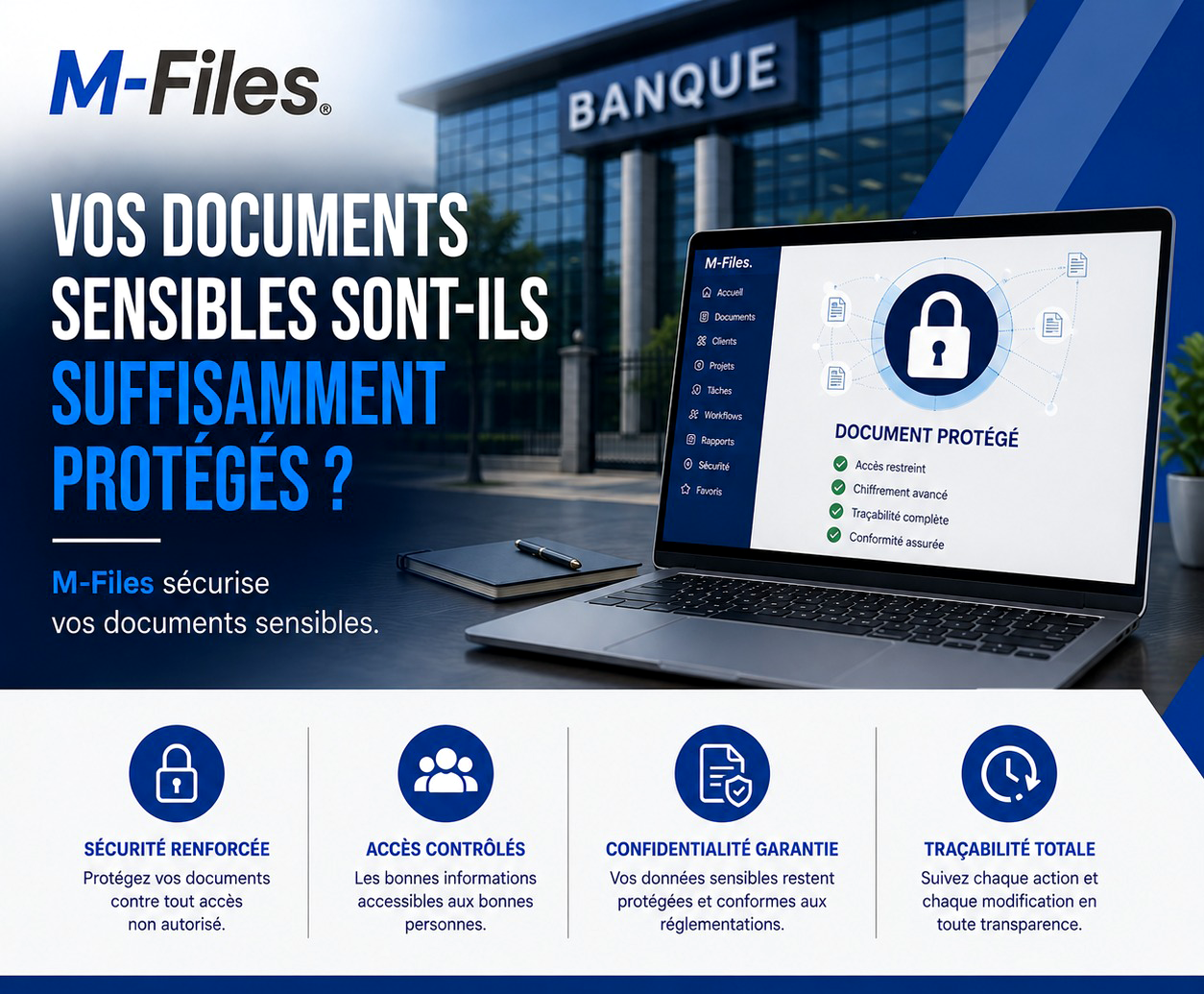
Confidentiality & banking secrecy
Are your sensitive documents protected enough?
Shared folders open to everyone, client information looked up for no reason... Here's Aïcha's story — and what would have changed with M-Files.
Galaxy Conseils • Banking & financial institutions
Saturday night, Aïcha is invited to a wedding. The mood is festive, the music loud. During dinner, an acquaintance comes to sit next to her. She works at the front desk of Aïcha's bank branch.
Somewhere in the conversation, she slips in with a smile :
"So, how's that mortgage going? With your salary, it must be no problem at all."
Aïcha freezes. She has never discussed her loan with this person, let alone her salary.
On Monday, she goes to the branch to understand. A little embarrassed, they explain that client files are kept in a shared folder on the branch network. All staff can access it, from the front desk to management. And no one can say who viewed her file, or when.
Nothing was stolen. But Aïcha feels like her financial life has become a topic of conversation. And she seriously wonders whether she should stay with this bank.
When people talk about data protection, they think first of hackers and burglars. Yet a large share of information leaks comes from the inside, most often with no bad intent : a curious colleague, a printed document left lying around, a folder shared too broadly.
In a bank, sensitive documents are everywhere : ID documents, pay slips, bank statements, loan contracts, collateral, client correspondence. And in many organizations, their protection rests on fragile habits :
The consequences are serious : lost client trust, the risk of information being misused, and failure to meet regulatory requirements on personal data protection and banking secrecy.
A client entrusts their bank with what they tell almost no one else : what they earn, what they owe, what they own. That trust rests on a simple promise : their information will only be seen by those who genuinely need it.
Keeping that promise can't rely solely on everyone's discretion. The organization itself has to guarantee it : through access rules that are clear, automatically enforced, and verifiable.
Let's replay Aïcha's story, this time at a bank that uses M-Files.
✓ Restricted access. In M-Files, Aïcha's credit file is only visible to the people who need to process it : her advisor, the credit analyst, the legal department, and decision-makers. The front-desk agent sees that Aïcha is a client, but not her salary or the details of her loan.
✓ Role-based rights. Access is defined by each person's function and applied automatically. When an employee changes roles, their rights change with them.
✓ Advanced encryption. Documents are stored encrypted : they can't be read by accessing the server's files directly. Viewing them requires going through M-Files, with the right permissions.
✓ Full traceability. Every view is logged : who opened the file, and when. If a question comes up, the bank can check within minutes.
At the wedding, the conversation stays on the music and the newlyweds. Aïcha's information stayed exactly where it belonged : between her and her bank.
Stronger security. Your documents are protected against any unauthorized access, inside the bank as well as outside it.
Controlled access. The right information reaches the right people, no more and no less. Rights follow roles and update automatically.
Guaranteed confidentiality. Your sensitive data stays protected and compliant with regulations, thanks to encryption and access rules enforced everywhere.
Total traceability. Every action and every change is tracked with full transparency. In case of doubt or a review, you know exactly who saw what.
In a typical shared folder, rights are assigned folder by folder, often once and then forgotten. With M-Files, security follows the document itself : depending on what it is (an ID document, a contract, a statement) and which client it belongs to, the right access rules apply automatically.
The document stays protected wherever it appears in the system, with no one on the team having to think about it. And the bank can prove at any time that its confidentiality rules are genuinely being applied.
It's the same foundation that guarantees traceability, a single version of each document, and their protection in the event of theft or disaster. Confidentiality isn't an option bolted on afterward : it's built into everyday document management.
Try this with the file of one of your most important clients.
"How many people at your bank can open this file today? And how many actually need to?"
If the gap between those two numbers surprises you, your clients have every reason to be concerned.
At Galaxy Conseils, we help banks and financial institutions protect their sensitive documents with M-Files : role definition, access rights, encryption, and traceability, starting from their real-world organization. Want to see exactly what this would look like at your bank?
Galaxy Conseils: innovation in service of your performance.
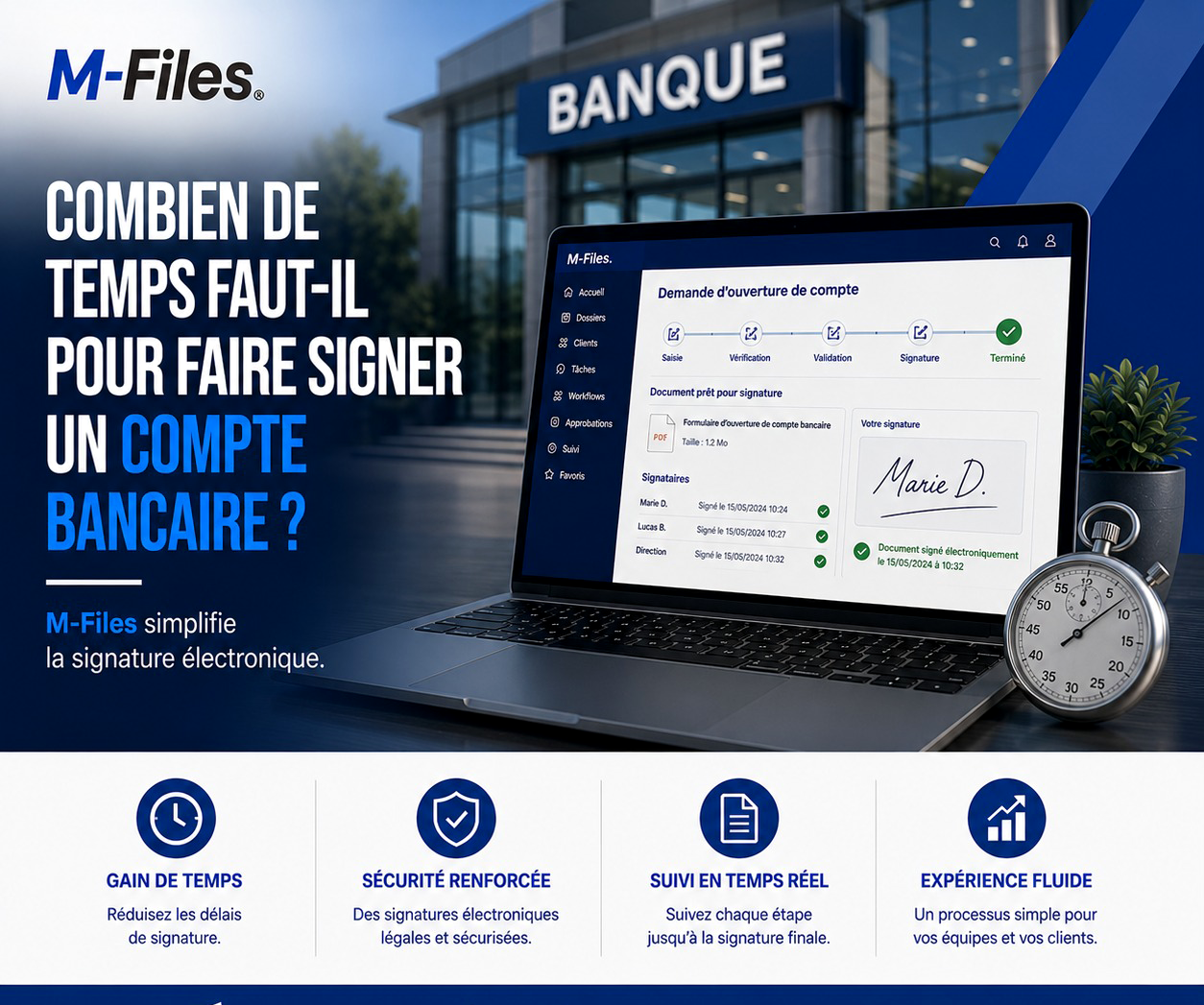
Clients on the road, internal signatures dragging on, forms sent by post... Discover how M-Files simplifies electronic signature for banking documents.
Read more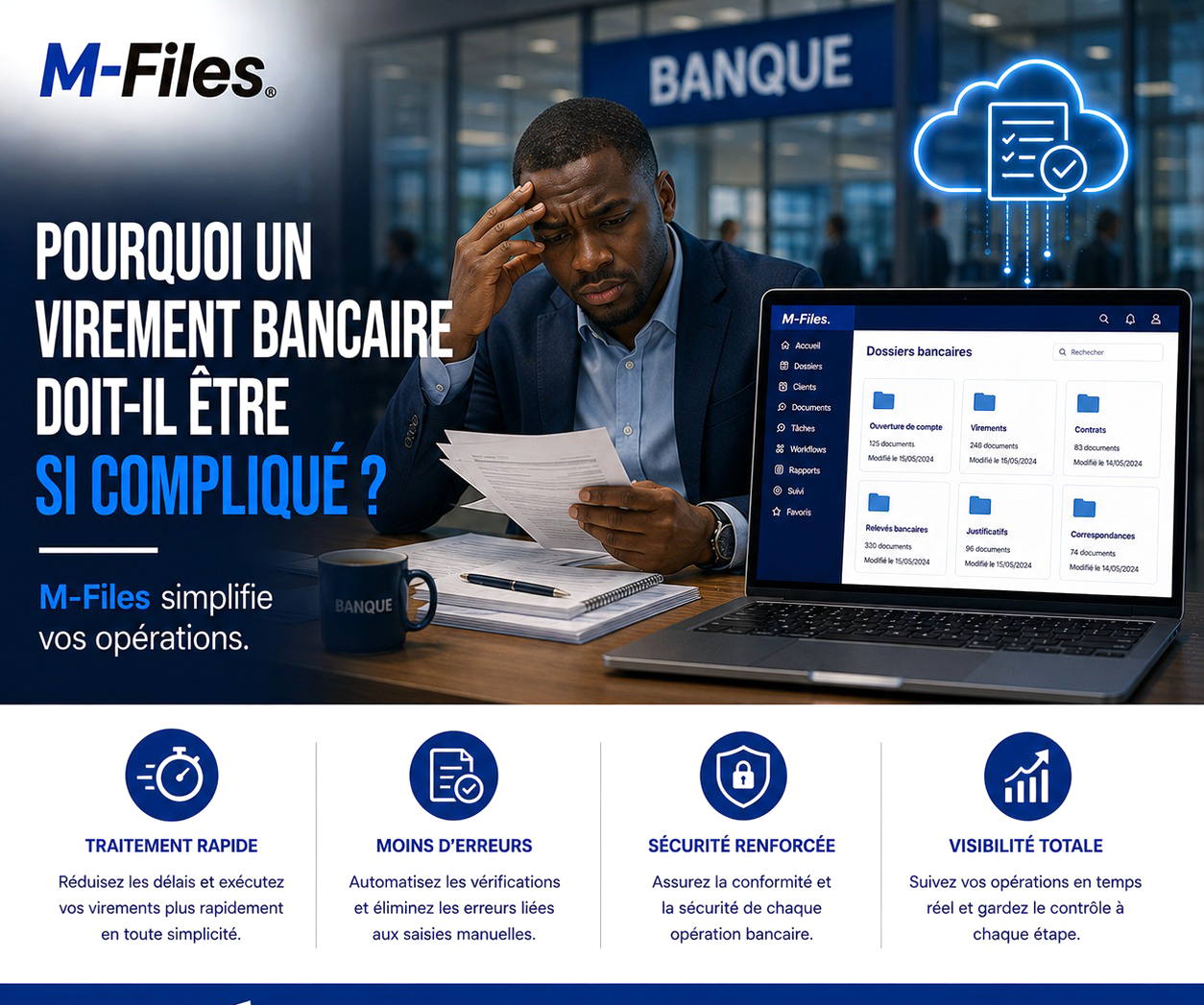
Incomplete transfer orders, misplaced supporting documents, data-entry errors, clients left waiting... Discover how M-Files simplifies the document workflow behind bank transfers.
Read more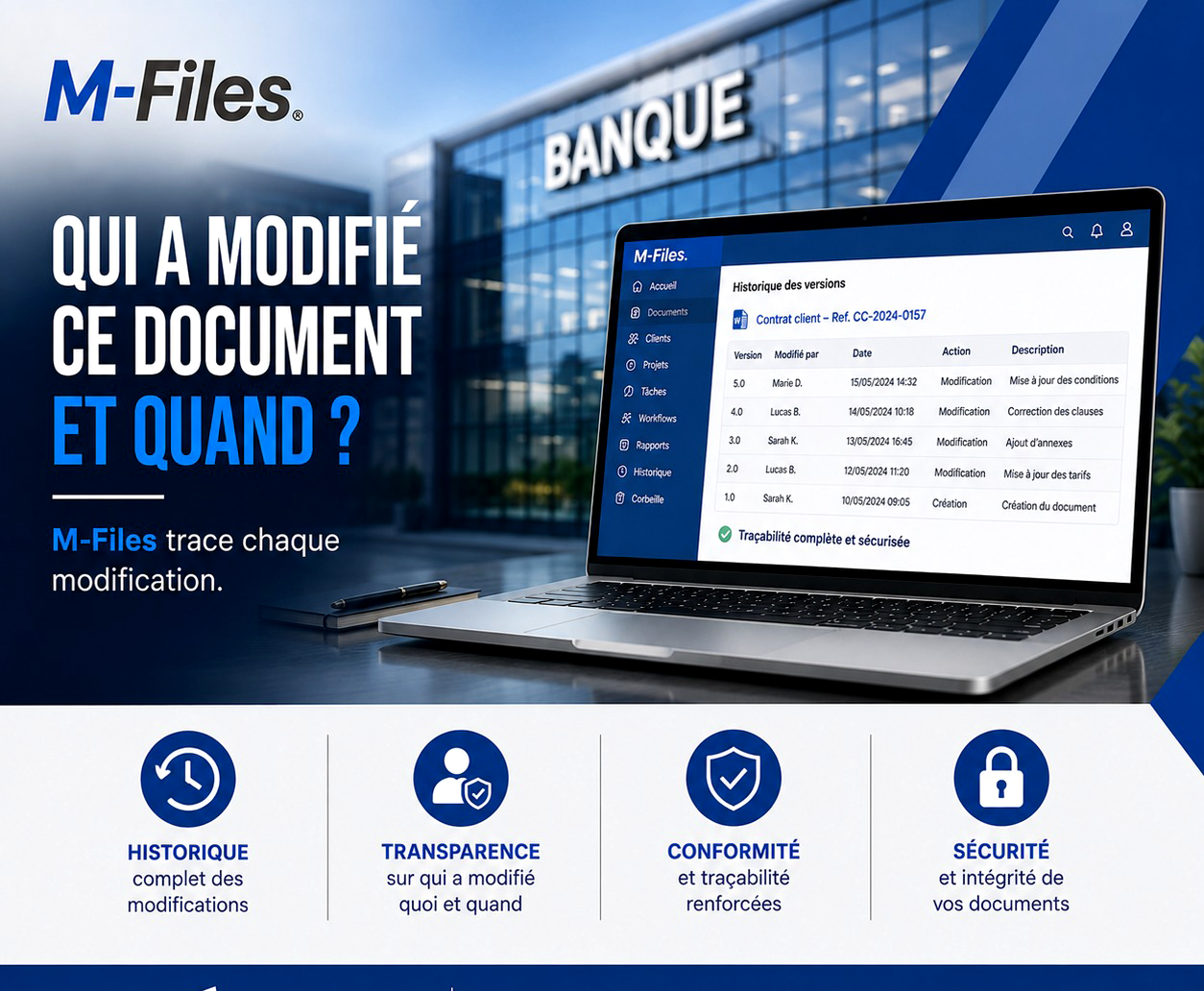
What clause was in the contract on signing day? Discover how M-Files' version history lets you trace every change, its author, and its date.
Read moreContact us to learn more about our news and upcoming events.
Comments
No comments yet. Be the first to react!