
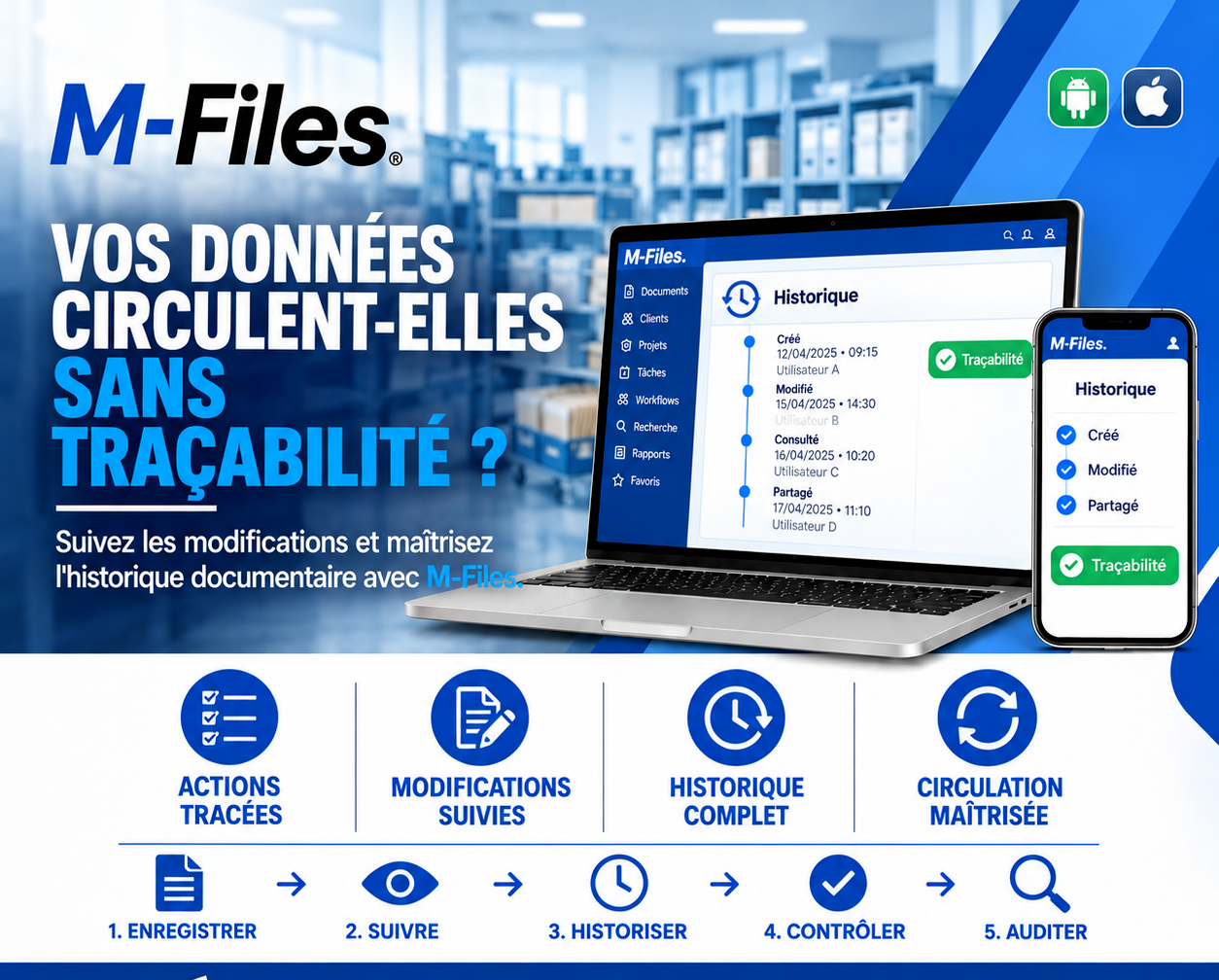
IS YOUR DATA CIRCULATING WITHOUT TRACEABILITY?
Tracked actions, monitored changes, complete history, controlled circulation: discover how M-Files follows every document, from creation to sharing.
Galaxy Conseils • Document traceability & compliance
Société Alpha is responding to a major tender: equipping every branch of a regional bank. The commercial proposal is drafted by the sales director, enriched by the technical manager, reviewed by the accountant for pricing, then validated by Aïcha.
For two weeks, the file circulates. By email, for reviews. On WhatsApp, to move faster. On a USB drive, to work over the weekend. Everyone edits their own copy, then sends it back to the others.
On the day the bid is submitted, the proposal goes out. A week later, the bank calls: the price of one lot doesn't match the technical detail, and a discount appears that Aïcha never approved. Who changed that price? When? On which version? Who was the file sent to? No one can answer with certainty.
Aïcha has to explain the error to her client and honor a price she never chose. She realizes her company's most sensitive documents are circulating without leaving any trace.
In a company, documents don't stay put: they are created, edited, reviewed, shared internally and externally. That's normal. What isn't normal is for that circulation to happen with no trace at all.
Multiple copies. Every send by email, chat, or USB drive creates a new version.
Anonymous edits. There's no way to know who changed a figure or a clause.
Invisible sharing. No one knows who the document was sent to, internally or externally.
No way to verify. In case of an error or dispute, the history has to be reconstructed from memory.
For a company, this lack of traceability is a commercial risk. For a bank, it's also a regulatory one.
The solution is to let information circulate without scattering it. The document stays in one place; it's the access that circulates. And every action — creation, modification, viewing, sharing — is logged automatically.
Let's replay Aïcha's story, this time with a Société Alpha working with M-Files.
1. Record. The sales director creates the proposal in M-Files. The history logs: "Created," with the date, time, and his name.
2. Track. The technical manager and the accountant work on the same document, each in turn. Every change is logged: "Modified," by whom and when.
3. Keep history. Every version is kept. Aïcha reviews the proposal to approve it: "Viewed." Then the proposal is sent to the bank: "Shared," with the date of sharing.
4. Check. Before submission, Aïcha compares the latest version with the one she reviewed. She immediately spots the discount added without her approval, and has it corrected.
5. Audit. Weeks later, if a question comes up, the history shows who did what, when, and on which version. The "Traceability" badge is there on screen to remind everyone.
The proposal goes out with the correct prices. If the bank asks a question, Aïcha has the answer in seconds. And her teams have stopped sending each other copies over WhatsApp.
Tracked actions. Creation, modification, viewing, sharing: every action is logged, with its author and date.
Monitored changes. Every version is kept. You know what changed, and who changed it.
Complete history. A document's entire life is available to view, on computer as well as on mobile.
Controlled circulation. The document stays in the same place; it's the access that circulates. No more uncontrolled copies.
In M-Files, sharing a document doesn't mean sending a copy of it. You grant access to the document, inside the company, or outside it through controlled sharing links where configuration allows it. The document stays unique, and every access is tracked.
The activity log and version history automatically record what happens to each document. No one has to keep a manual register, and an ordinary user cannot erase these traces.
For a company as for a bank, this is a solid basis for answering a client, an auditor, or a regulator.
Ask yourself:
"If a figure changed in one of your most sensitive documents, could you say who modified it, when, and who the document was sent to afterward?"
If the answer is no, your data is circulating without traceability.
At Galaxy Conseils, we help companies and financial institutions take control of their document circulation with M-Files, from creation through to audit. Want to see concretely what this would look like at your company?
Galaxy Conseils: innovation serving your performance.
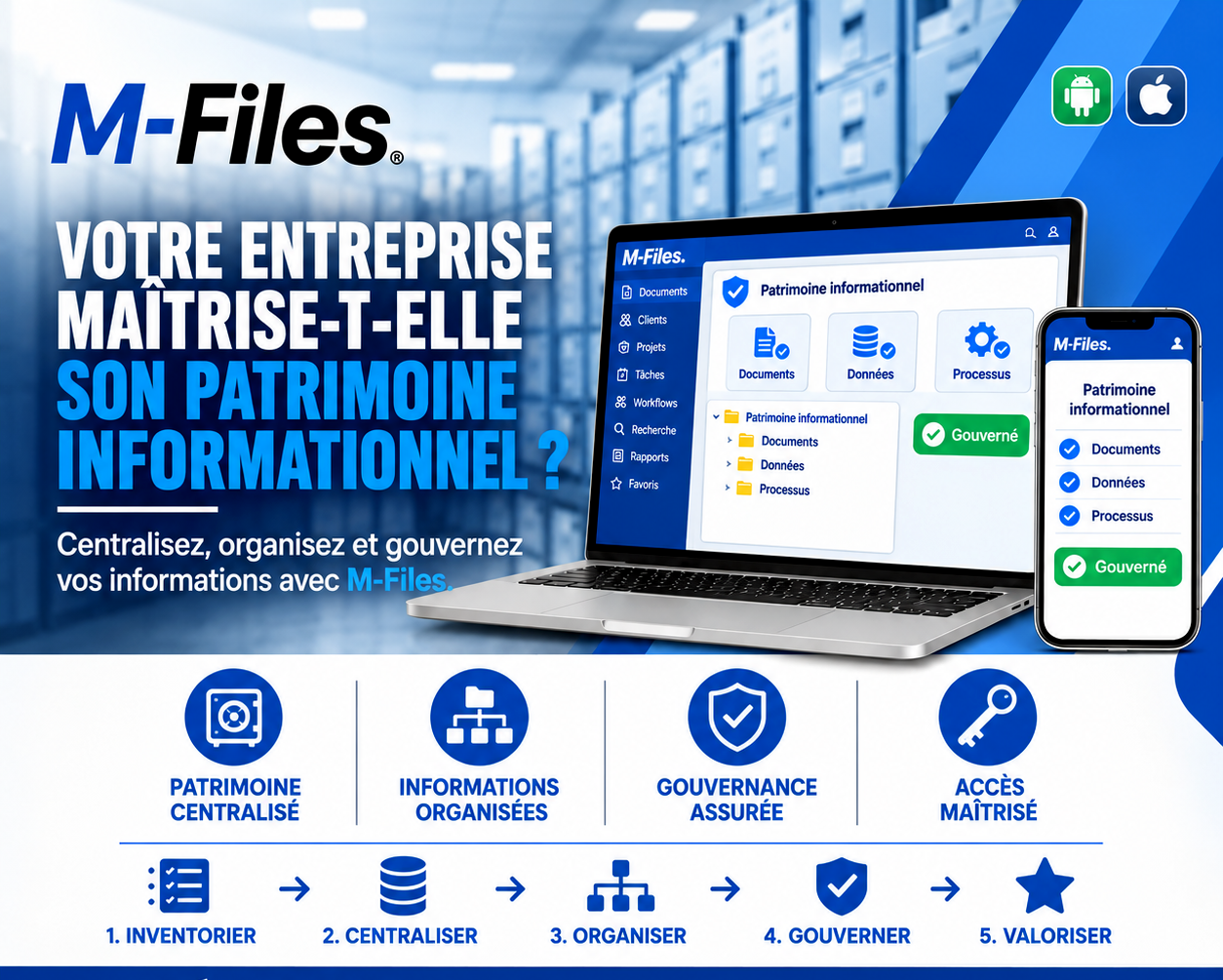
Does your company master its information assets? Documents, data and processes centralized, organized and governed: discover how M-Files turns information into an asset.
Read more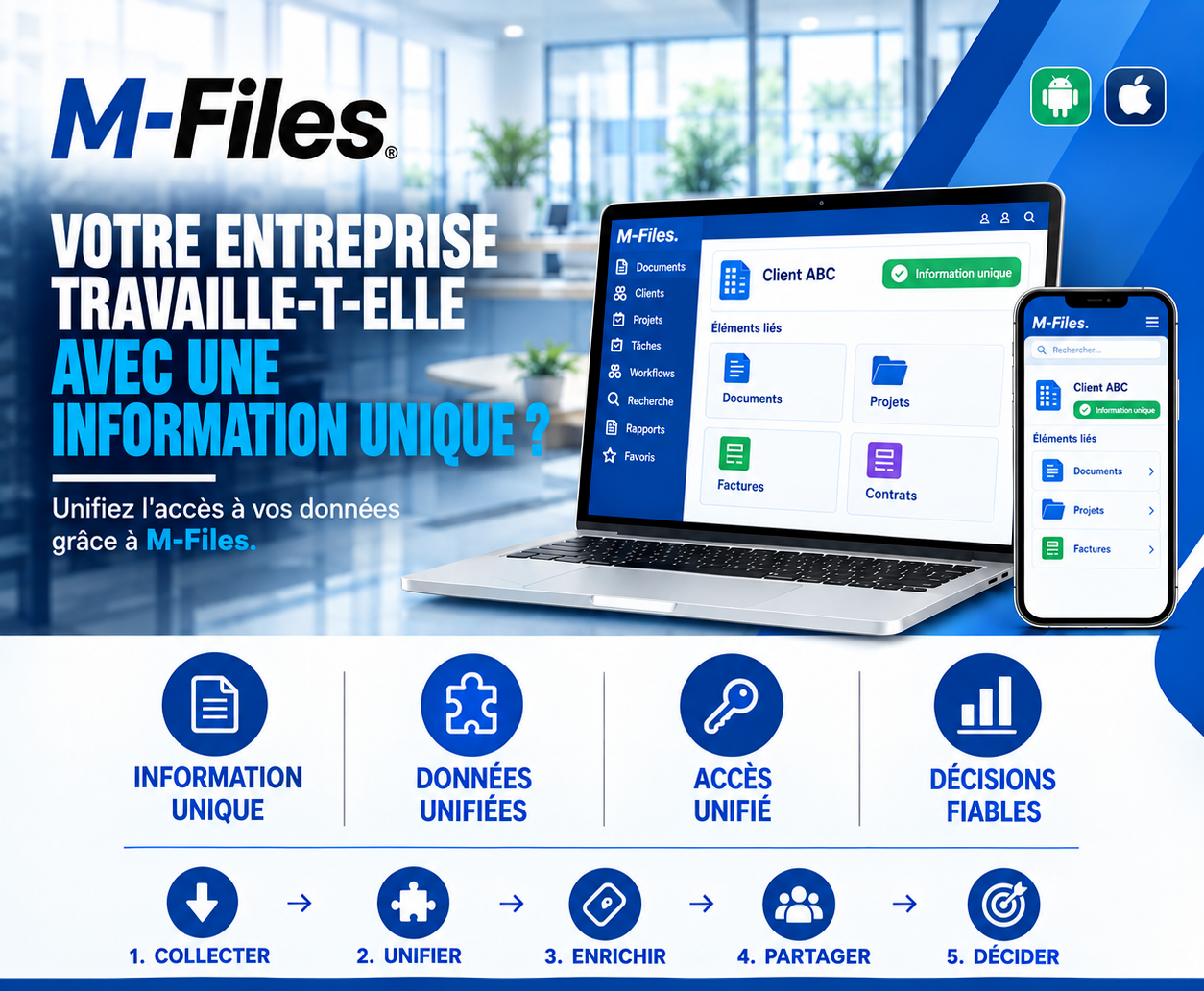
Does your company work with a single source of information? Single source of truth, unified data, unified access, reliable decisions: discover how M-Files gives a complete view of every client.
Read more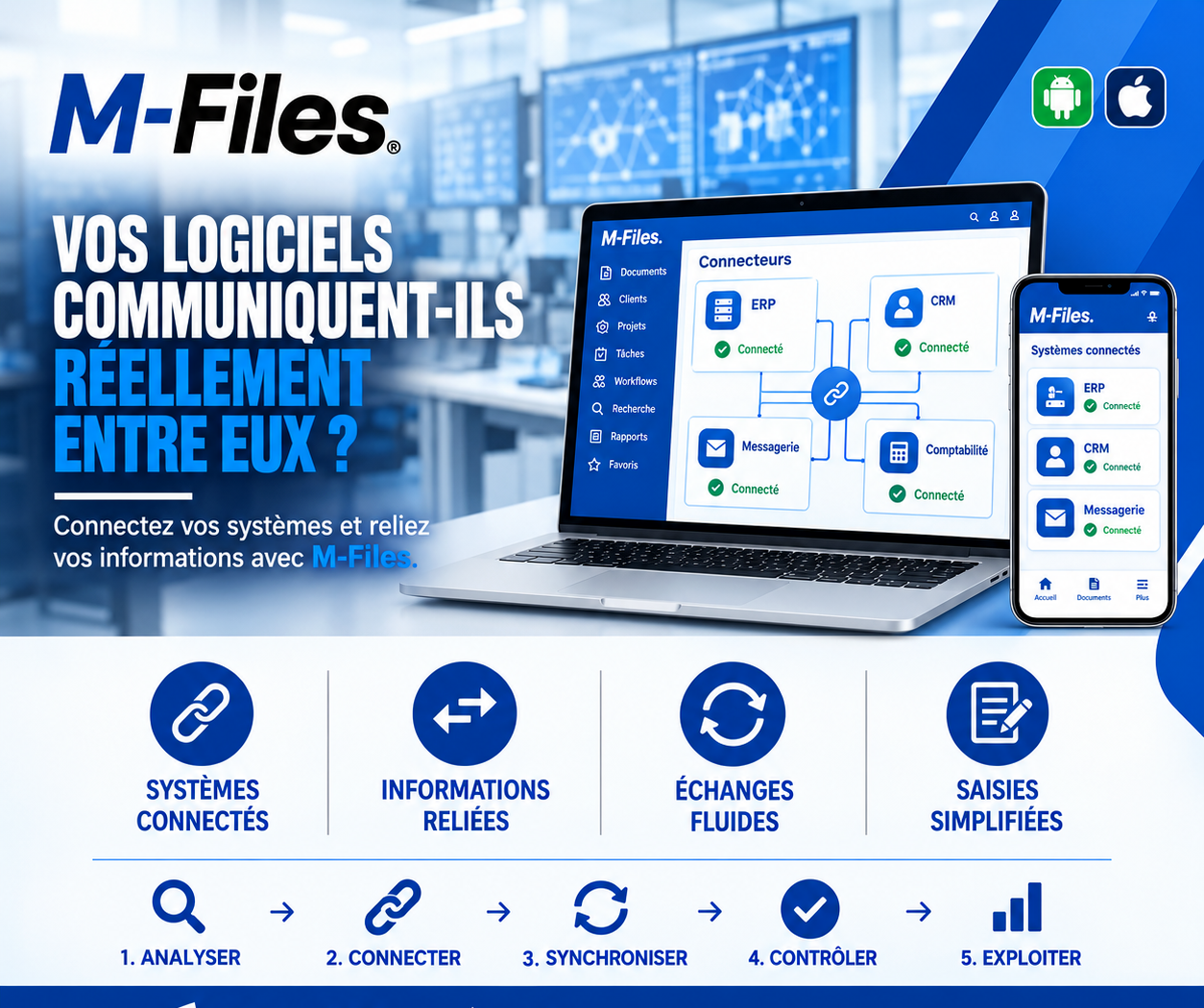
Do your software systems really talk to each other? Connected systems, linked information, smooth exchanges, simplified data entry: discover how M-Files connectors eliminate double entry.
Read moreContact us to learn more about our news and upcoming events.
Our offers, news and document management tips, straight to your inbox. One e-mail a month at most.
Unsubscribe in one click at any time. Privacy policy
Check your inbox
We've sent you a confirmation link. Click it to complete your sign-up.
Comments
No comments yet. Be the first to react!