
Traceability & document compliance
Who changed this document, and when?
What clause was in the contract on signing day? Here's Aïcha's story — and what would have changed with M-Files.
Galaxy Conseils • Banking & financial institutions
Three years have passed. Aïcha is well settled into her house, and this year, she received a nice bonus. She has an idea in mind : paying off part of her mortgage early.
She remembers the conversation before signing clearly. Her advisor had explained : "After three years, you'll be able to make early repayments with no penalty." The clause had even been added at her request.
She goes to the branch, confident. But the answer comes back :
"Ma'am, the contract provides for a 5% penalty on the amount repaid."
Aïcha pulls out her paper copy. A page is missing — the appendix, lost during the move. The advisor opens the contract file on the server : it only shows the current version. The document was edited several times before signing, then reused as a template. No one can say for certain what the clause read on the day Aïcha signed.
Aïcha is certain of what she was promised. The bank can neither confirm nor deny it. And that's the start of a dispute.
A bank contract almost always evolves before it's signed : terms get updated, clauses get corrected, appendices get added, rates get adjusted. That's normal.
The problem starts when each change overwrites the one before it. The file then shows only its latest state, saying nothing about the path it took to get there :
In a bank, this lack of memory is costly. A dispute that can't be settled often ends with an expensive goodwill gesture, or with a damaged client relationship.
Finding a contract is useful. But in a disagreement, the real question is often elsewhere : what exactly did this document say at a given moment, and who has changed it since?
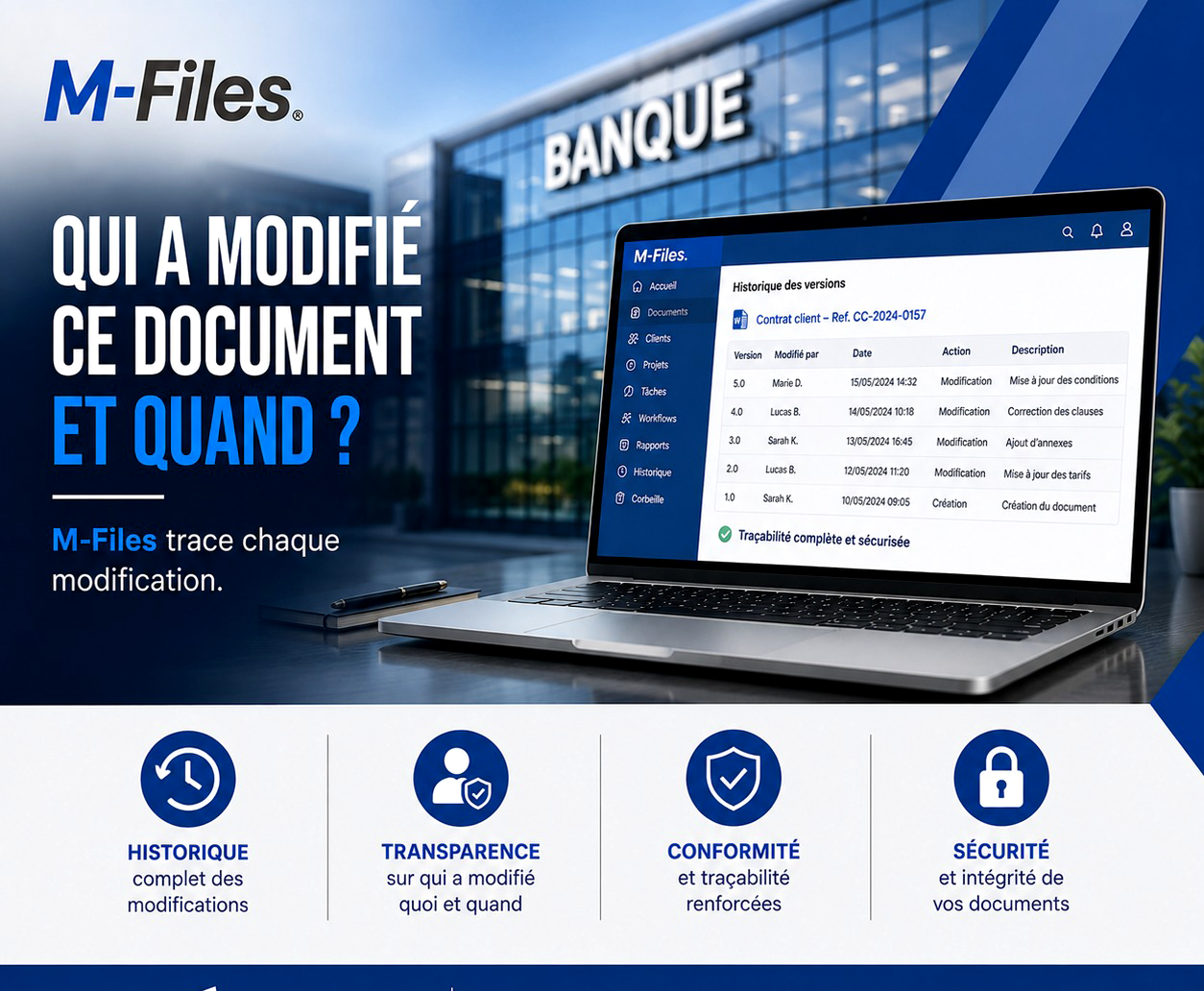
Answering that requires a complete version history : every state of the document, kept, dated, attributed to its author, and accompanied by a description of what changed.
Let's replay Aïcha's story, this time at a bank that uses M-Files.
The advisor opens Aïcha's contract, reference CC-2024-0157, and pulls up its version history :
In a few clicks, she opens the version Aïcha signed and finds the clause : early repayment with no penalty after three years. She also sees where the mistake came from : the latest version, later reused as a template, contained an old wording.
The situation is resolved in half an hour. Aïcha repays part of her loan with no penalty, as agreed. And if the history had shown the opposite, the bank could have proven that too, with evidence to back it up.
Either way, the truth is established within minutes, and trust is preserved.
A complete history of changes. Every version of a document is kept automatically, with its date, author, and a description of what changed. Any earlier version can be reviewed, and you can roll back if needed.
Transparency on who changed what, and when. No more piecing together the facts from memory or emails. The information is right there, clear and shared.
Stronger compliance and traceability. During an audit or a review, you show exactly how each sensitive document evolved, with nothing to reconstruct.
Security and integrity for your documents. Past versions can't be rewritten. A document deleted by mistake can be restored. What was signed stays exactly as it was signed.
In a typical shared folder, saving a file means overwriting the previous one, or creating yet another copy. With M-Files, every save creates a new version of the same document, and together they form its history.
This memory is automatic : teams don't have to do anything differently. They edit the document in Word, and M-Files records the version, the author, the date, and the status.
What applies to a loan contract applies to every document a bank must be able to prove the content of : general terms, fee schedules, internal procedures, committee minutes, mandates.
Take a contract signed three years ago at your institution.
"Could you say, with certainty, what it contained on signing day, and who has changed it since?"
If the answer takes hours to track down, or stays uncertain, your next dispute may already be taking shape.
At Galaxy Conseils, we help banks and financial institutions keep a complete memory of their documents with M-Files, starting from their real drafting, approval, and archiving workflows. Want to see exactly what this would look like at your bank?
Galaxy Conseils: innovation in service of your performance.
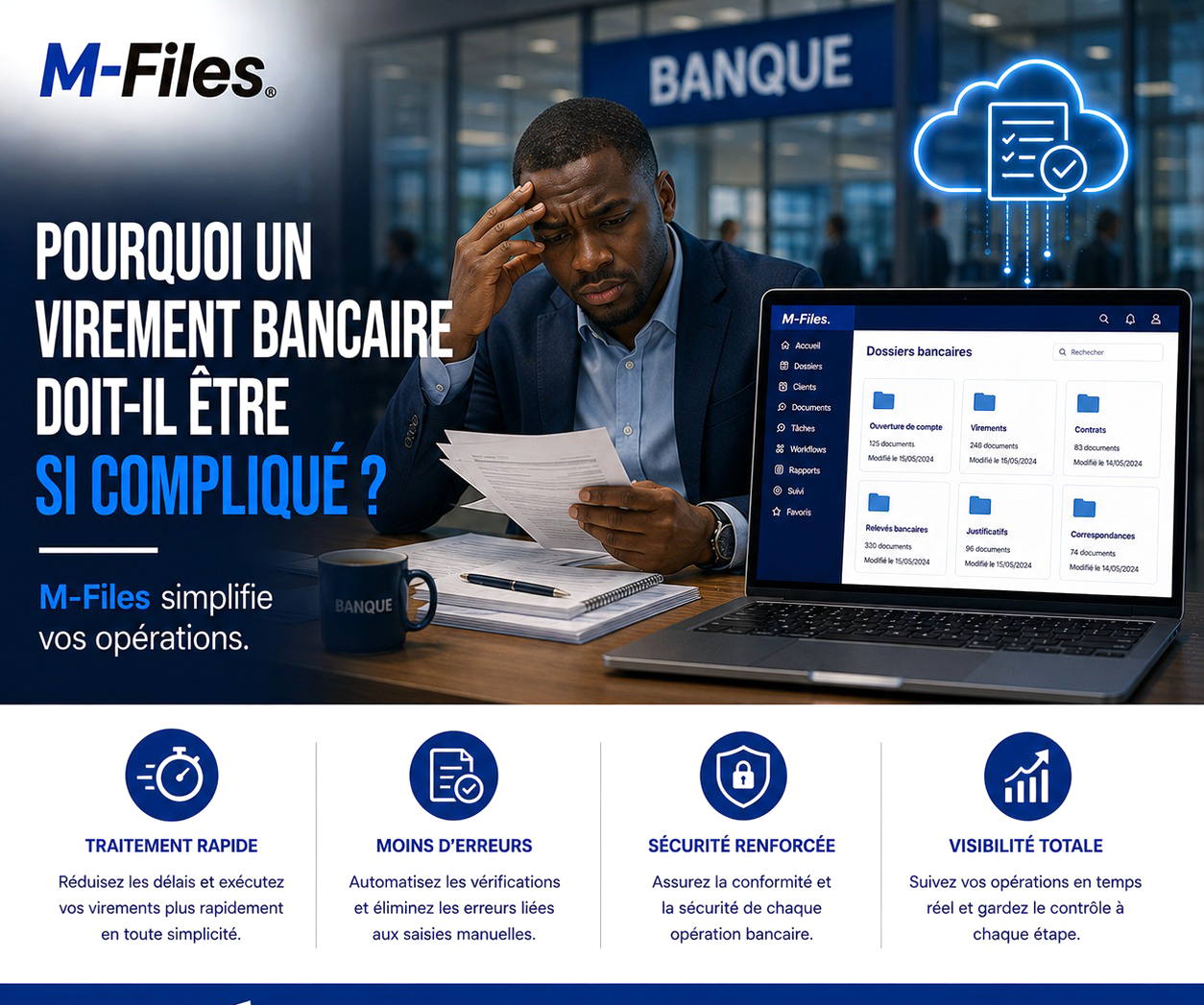
Incomplete transfer orders, misplaced supporting documents, data-entry errors, clients left waiting... Discover how M-Files simplifies the document workflow behind bank transfers.
Read more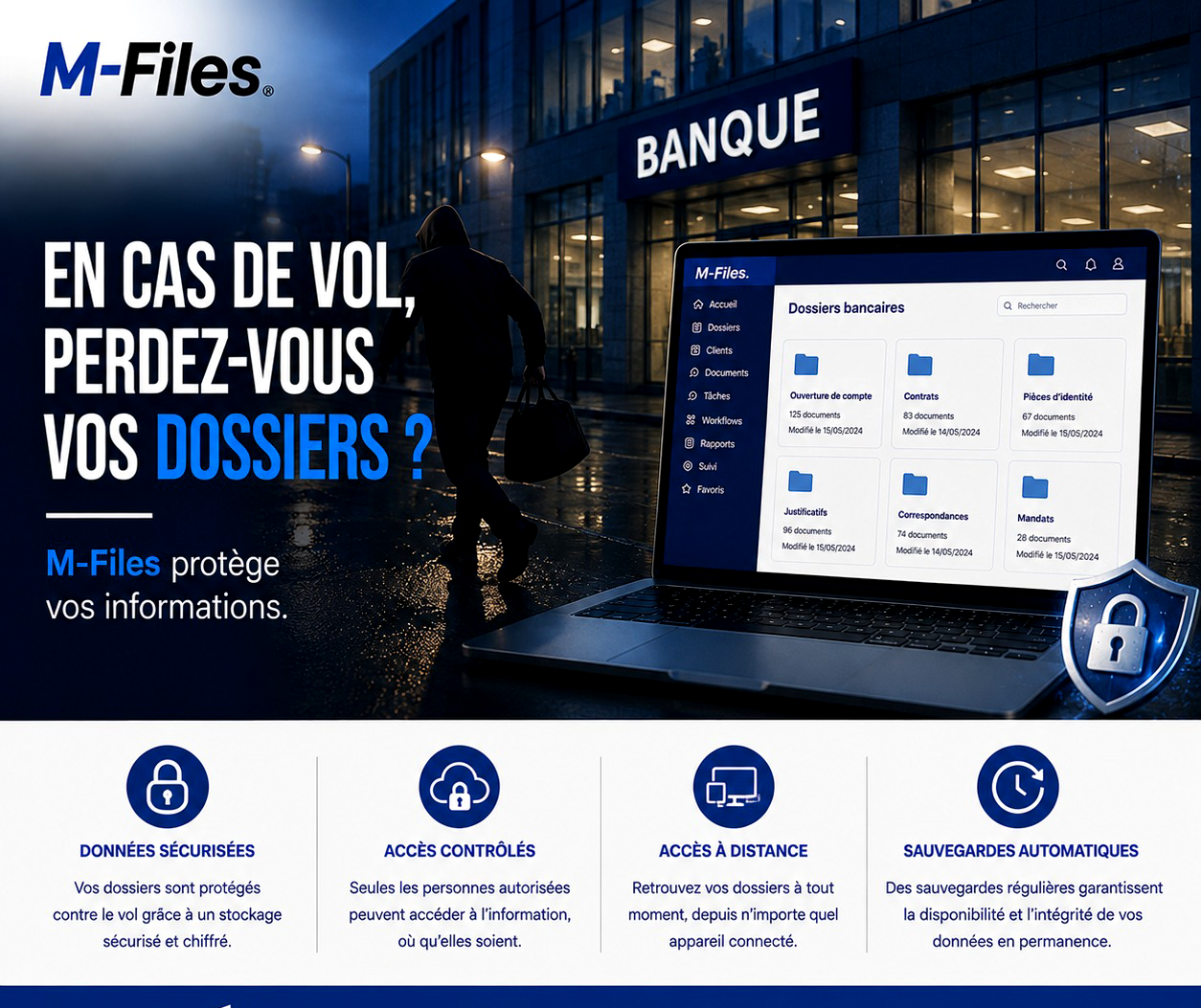
Break-in, stolen laptop, forced cabinet: what happens to your clients' files? Discover how M-Files protects your information through secure storage, controlled access, and automatic backups.
Read more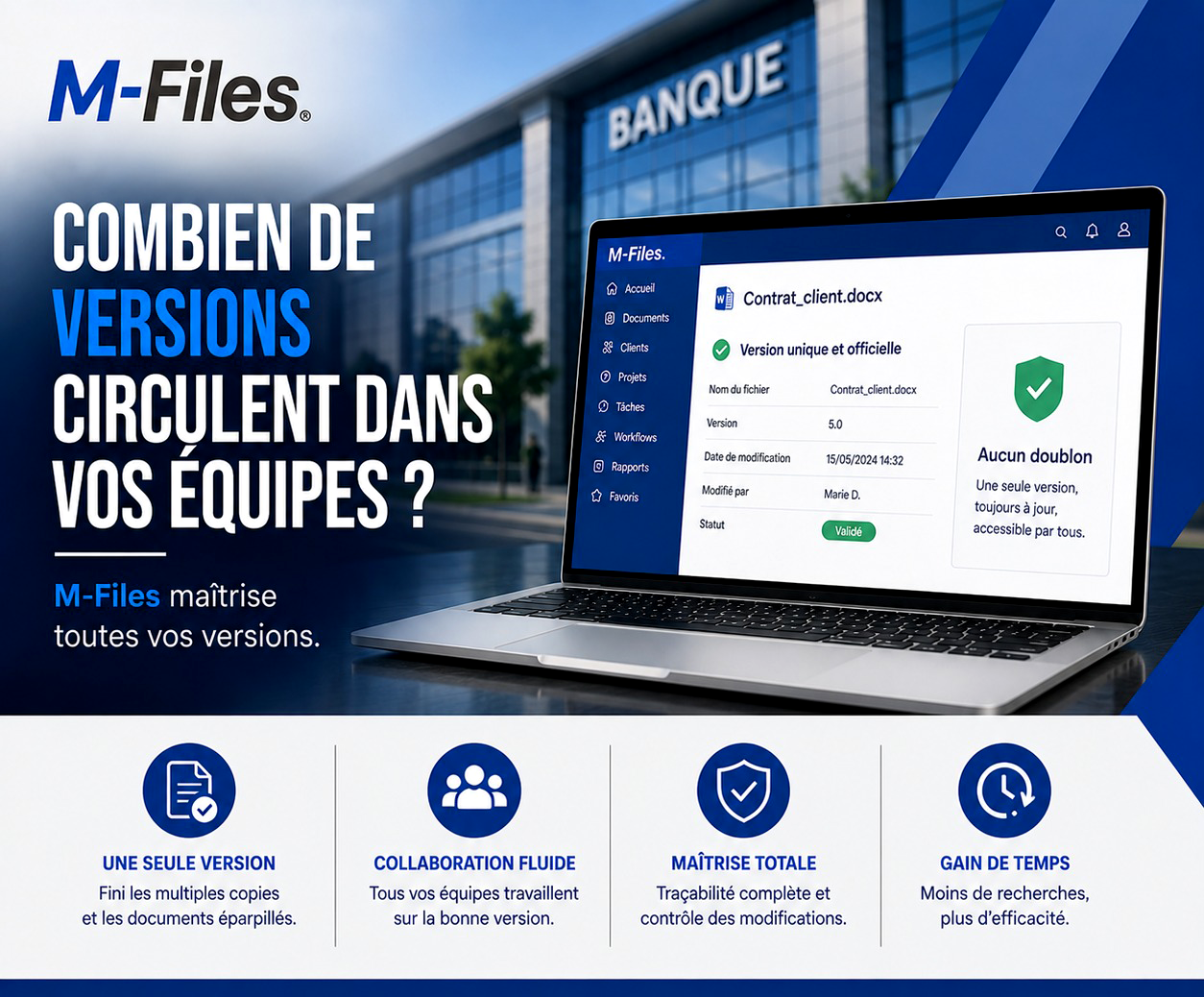
Contract_v2, Contract_final, Contract_final_OK... How many versions are circulating in your teams? Discover how M-Files guarantees a single, up-to-date, validated version.
Read moreContact us to learn more about our news and upcoming events.
Comments
No comments yet. Be the first to react!