
Operations & document efficiency
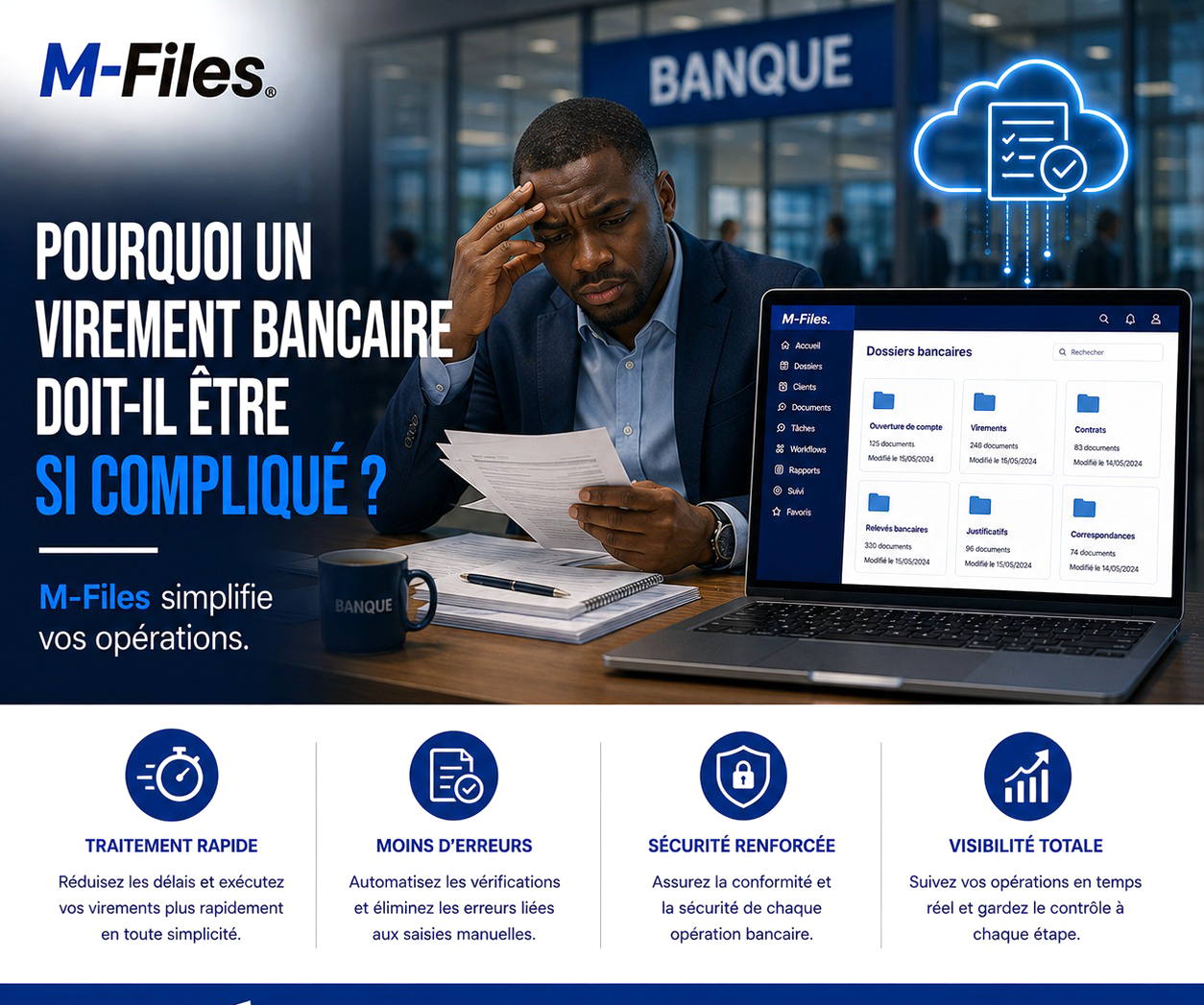
Why does a bank transfer have to be so complicated?
Incomplete transfer orders, misplaced supporting documents, data-entry errors, clients left waiting... Here's Aïcha's story — and what would have changed with M-Files.
Galaxy Conseils • Banking & financial institutions
Aïcha wants to equip her house with solar panels. She's found the right supplier, based abroad, who offers her a good price — on one condition : payment must arrive before the end of the month to lock in the order.
She goes to her branch with the pro forma invoice. The advisor has her fill out a paper transfer order, asks for a copy of the invoice, a copy of her ID, and a certificate. He staples it all together and sends it to the operations department.
A week goes by. No news. Aïcha calls. At the operations department, they search for her transfer order : it's waiting on a manager's approval. Then they discover a supporting document is missing. Then that a mistake crept into the beneficiary's account number, miscopied during data entry.
The file goes back to the branch. Aïcha has to come back in to sign a new order.
The transfer finally goes out three weeks late. In the meantime, the supplier has sold the batch to another client, and the price has gone up.
From a client's point of view, a transfer looks simple : an amount, a beneficiary, an account number. But for the bank, it's a real file, especially when the amount is large or the transfer goes abroad.
It needs a signed order, supporting documents, compliance checks, sometimes several levels of approval. And when all of that moves around on paper or by email, problems pile up :
Every mistake costs time, and sometimes money. It can also create a compliance risk if a required document is missing at the time of a review.
Banks are right to be strict about transfers : checking, verifying, and keeping supporting documents is part of their role. The problem isn't the checking itself, but how it's organized.
When documents are in the right place, complete, and visible to the right people, checks become fast. The bank stays just as rigorous, but the client no longer waits.
Let's replay Aïcha's story, this time at a bank that uses M-Files.
At the branch. Aïcha's transfer order and supporting documents are scanned and filed under "Transfers," attached to her client record. M-Files immediately checks that the required documents are present. If one is missing, the advisor sees it before Aïcha leaves.
Checks. The order's key details (beneficiary, amount, references) are checked against the attached documents. Checks are automated as much as possible, which cuts down on errors from manual entry.
Approval. The file automatically moves to the operations department, then to the manager who must approve it. Each person gets a notification and sees the complete file.
Tracking. At every step, the transaction's status is visible. If Aïcha calls, her advisor knows within seconds where her transfer stands.
Once the transfer is executed, the order, the supporting documents, and the confirmation are archived together, alongside her bank statements. If there's a review, everything is already in place.
The transfer goes out on time. The solar panels are delivered the following month, and Aïcha is convinced her bank can move fast without cutting corners.
Faster processing. Turnaround shrinks and transfers get executed faster, simply because no file is left waiting on a desk.
Fewer errors. Checks are automated and errors from manual entry are sharply reduced. An incomplete file is spotted right from the start.
Stronger security. Compliance and security are ensured for every transaction : supporting documents kept, access rights controlled, every action tracked.
Total visibility. You track your transactions in real time and keep control at every step, from the branch to the archive.
M-Files doesn't replace the system that executes transfers. It handles everything around it : signed orders, supporting documents, checks, approval workflows, and archiving.
Every transfer file is linked to the client, their statements, their contracts, and their correspondence. Teams work with complete, up-to-date documents instead of chasing stapled sheets of paper.
It's the same logic that speeds up account opening, loan processing, and mail tracking : documents in the right place, steps defined in advance, and information visible to the people who need it.
Take the transfers processed last week at your institution.
"How many were delayed by a missing document, a data-entry error, or an approval left waiting?"
If you don't have the answer, that may well be a sign that you're missing visibility.
At Galaxy Conseils, we help banks and financial institutions simplify the document workflow behind their transactions with M-Files, starting from their real-world checking and approval procedures. Want to see exactly what this would look like at your bank?
Galaxy Conseils: innovation in service of your performance.
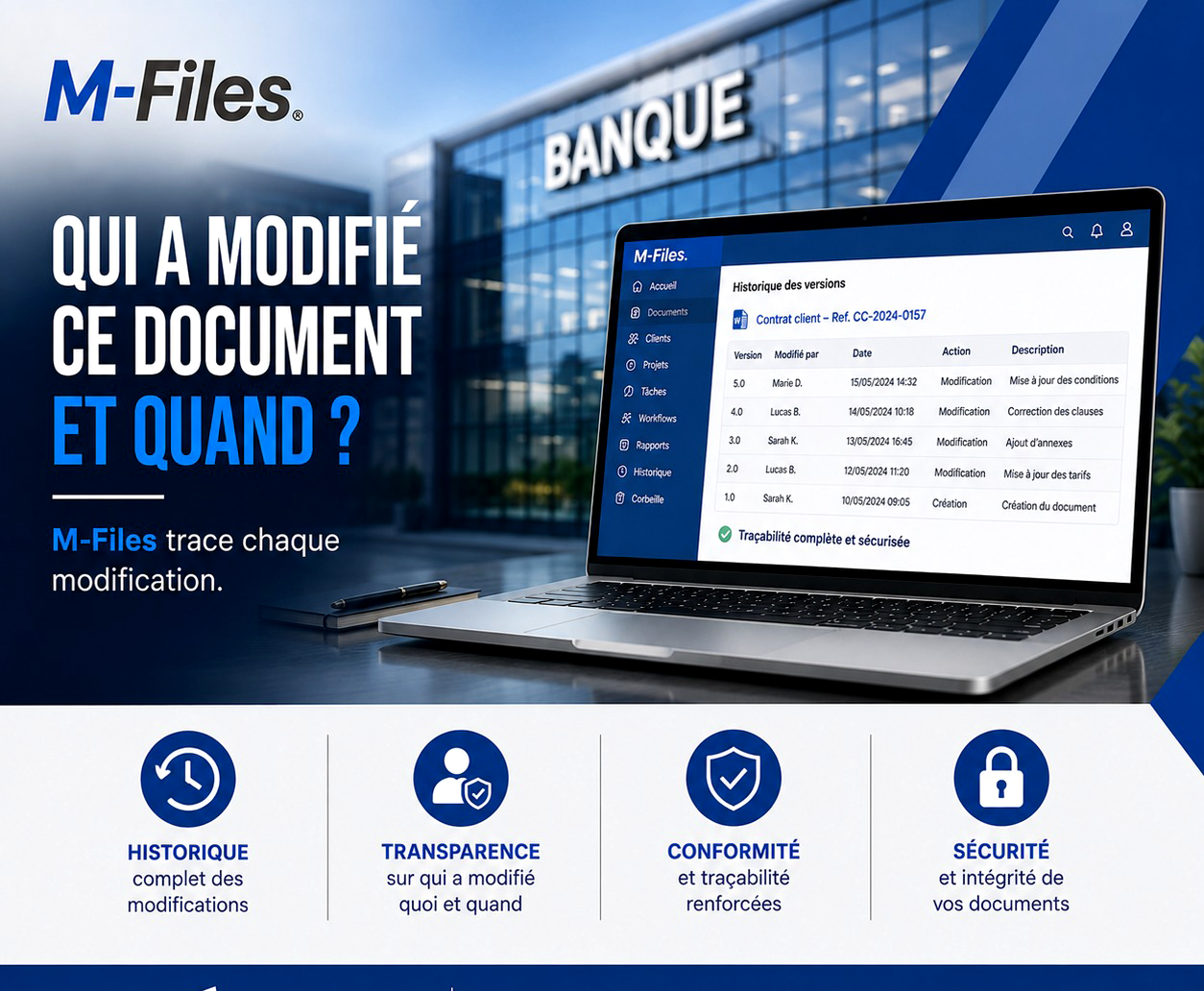
What clause was in the contract on signing day? Discover how M-Files' version history lets you trace every change, its author, and its date.
Read more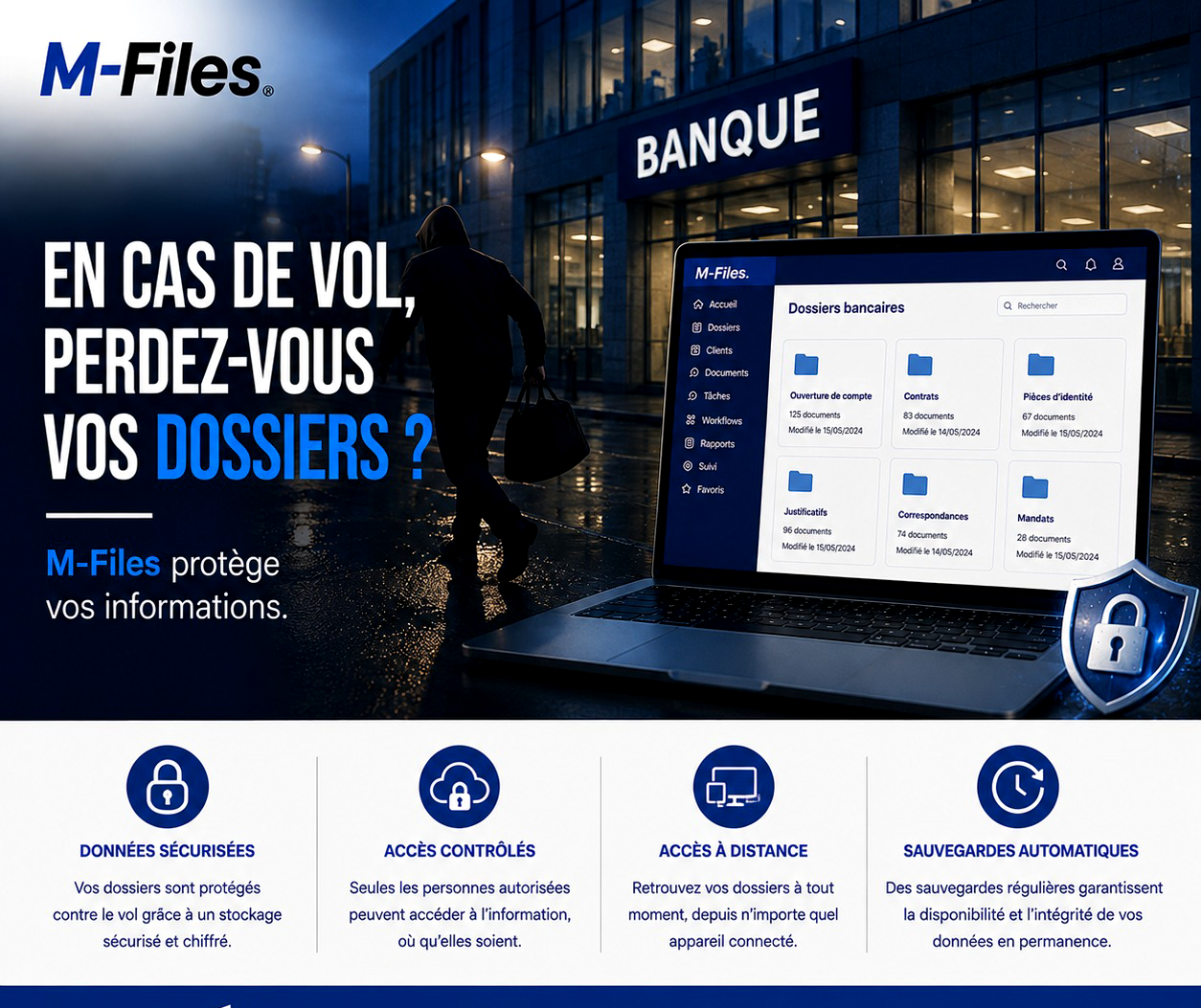
Break-in, stolen laptop, forced cabinet: what happens to your clients' files? Discover how M-Files protects your information through secure storage, controlled access, and automatic backups.
Read more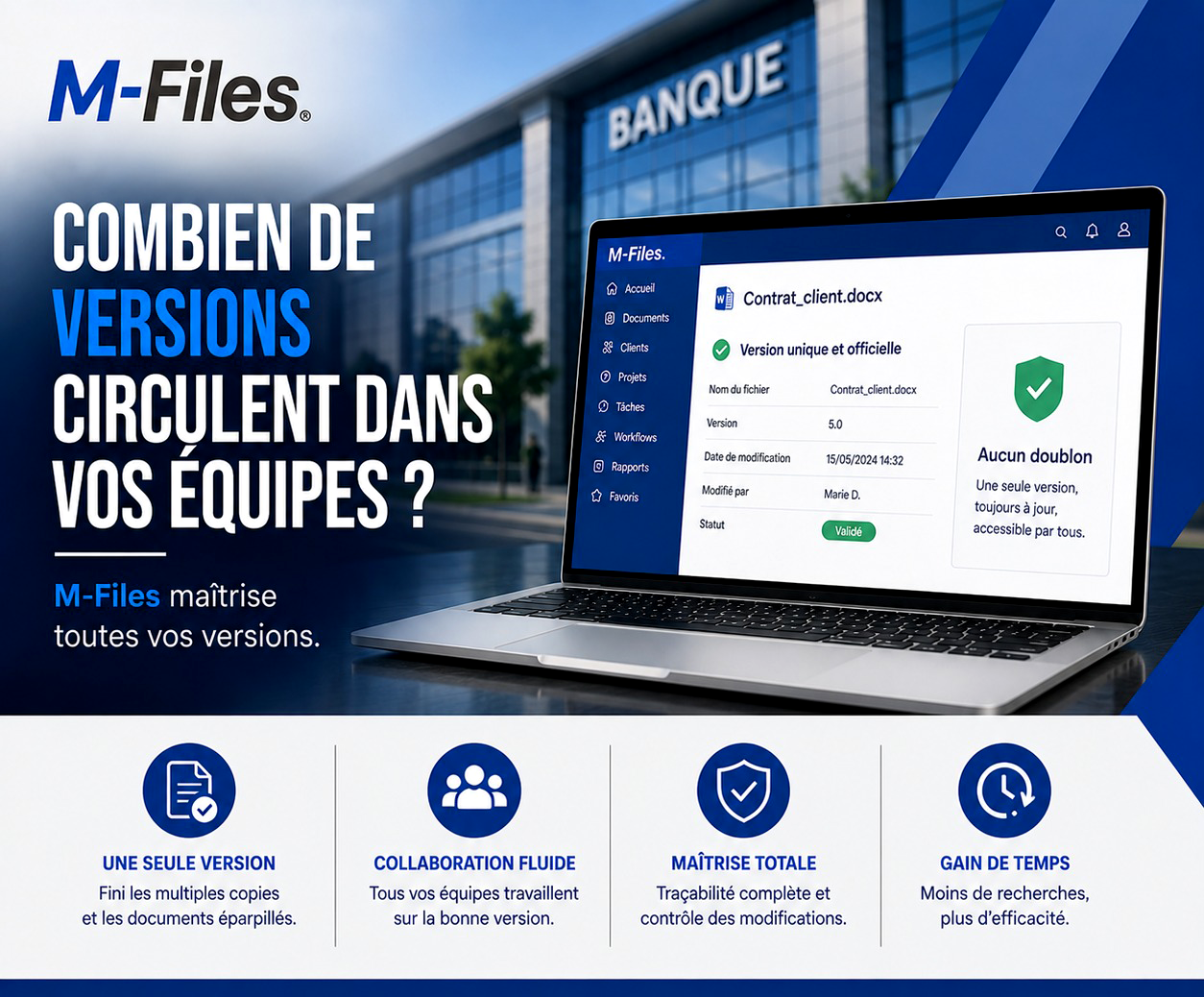
Contract_v2, Contract_final, Contract_final_OK... How many versions are circulating in your teams? Discover how M-Files guarantees a single, up-to-date, validated version.
Read moreContact us to learn more about our news and upcoming events.
Comments
No comments yet. Be the first to react!