

Lending & operational efficiency
Is a bank loan application taking too long?
Documents requested again, files shuttled from desk to desk, clients waiting for weeks... Here's Aïcha's story — and what would have changed with M-Files.
Galaxy Conseils • Banking & financial institutions
Aïcha found the house. Three bedrooms, a small garden, ten minutes from work. After paying off her car loan, this is the big project of her life.
The seller agrees, but sets one condition : "I'll hold it for you for 45 days. After that, I'll offer it to someone else."
The next day, Aïcha submits her mortgage application at the bank, with every document : pay slips, bank statements, the sale agreement, the seller's property title. She's confident. She's been a client for years, and everything is in order.
A week later, she gets a call : a pay slip is missing. She had already provided it. She resubmits it.
Two weeks later, the credit analyst is still waiting for the complete file, part of which stayed at the branch. The legal department hasn't yet received the collateral documents. And the credit committee doesn't meet for another ten days.
On day 40, Aïcha calls her advisor. "Your file is under review."
On day 46, the seller calls. The house has been sold to someone else.
In this story, no one dragged their feet on purpose. The advisor, the analyst, the legal officer, and the committee all did their job. The problem is the path the file has to follow.
A loan application is a chain of steps : gathering documents, financial analysis, credit review, collateral verification, then a decision. When the file is on paper or scattered across emails and shared folders, every step creates its own delays :
Every day of delay has a cost. For the client, it's an opportunity slipping away. For the bank, it's a loan that doesn't happen and a client who goes to a faster competitor.
A client applying for a loan almost always has a deadline : a house to secure, inventory to buy, a contract to honor. For them, a fast answer matters as much as a good rate.
Banks that respond quickly aren't taking on more risk. They've simply organized their files so information flows without friction.
Day 1, submission. Aïcha's documents are scanned and gathered into a single loan file. The system immediately checks for completeness : if a document is missing, the advisor sees it right away, and Aïcha completes it before even leaving the branch.
Days 2 to 5, analysis. The complete file is automatically forwarded to the credit analyst. At the same time, the legal department accesses the collateral documents. Everyone works from the same version, without waiting for the other to finish.
Day 8, the decision. The credit review is ready. Decision-makers receive a notification and review the complete file, even from their phone if they're traveling. They approve it.
Day 10, the answer. Aïcha receives her loan approval. Throughout the process, she was able to track exactly where her application stood.
On day 30, Aïcha signs at the notary's office. On day 45, she has the keys to her house.
Faster processing. Key steps are automated : routing, notifications, reminders. Turnaround shrinks at every step, without anyone having to chase a file.
Complete files. All documents are centralized in one place, and completeness is checked right at submission. No more asking the client for the same document three times.
Optimized collaboration. Advisors, analysts, legal officers, and decision-makers work on the same file, simultaneously if needed. Information flows without waiting on back-and-forth.
A better client experience. The client gets transparent tracking and a fast answer. They know where their application stands, and they recommend their bank.
With M-Files, a loan file isn't a stack of papers passed from desk to desk. It's a single digital file linking everything related to it : the application, the financial analysis, the supporting documents, the credit review, the collateral, and the final decision.
Every document is classified by what it is, and every step of the approval workflow is defined in advance. The bank keeps all its rigor in risk analysis, while eliminating the time lost between steps.
And Aïcha's loan file naturally joins her client record, alongside her account, her former car loan, and her exchanges with the bank. Her whole history is in one place.
Do the math for your institution :
"How many days pass between a loan application being submitted and the client getting an answer? And how many of those days are simply lost waiting?"
If the answer surprises you, your clients have probably already noticed.
At Galaxy Conseils, we help banks and financial institutions speed up the processing of their credit files with M-Files, starting from their real analysis and decision-making workflows. Want to see exactly what this would look like at your bank?
Galaxy Conseils: innovation in service of your performance.
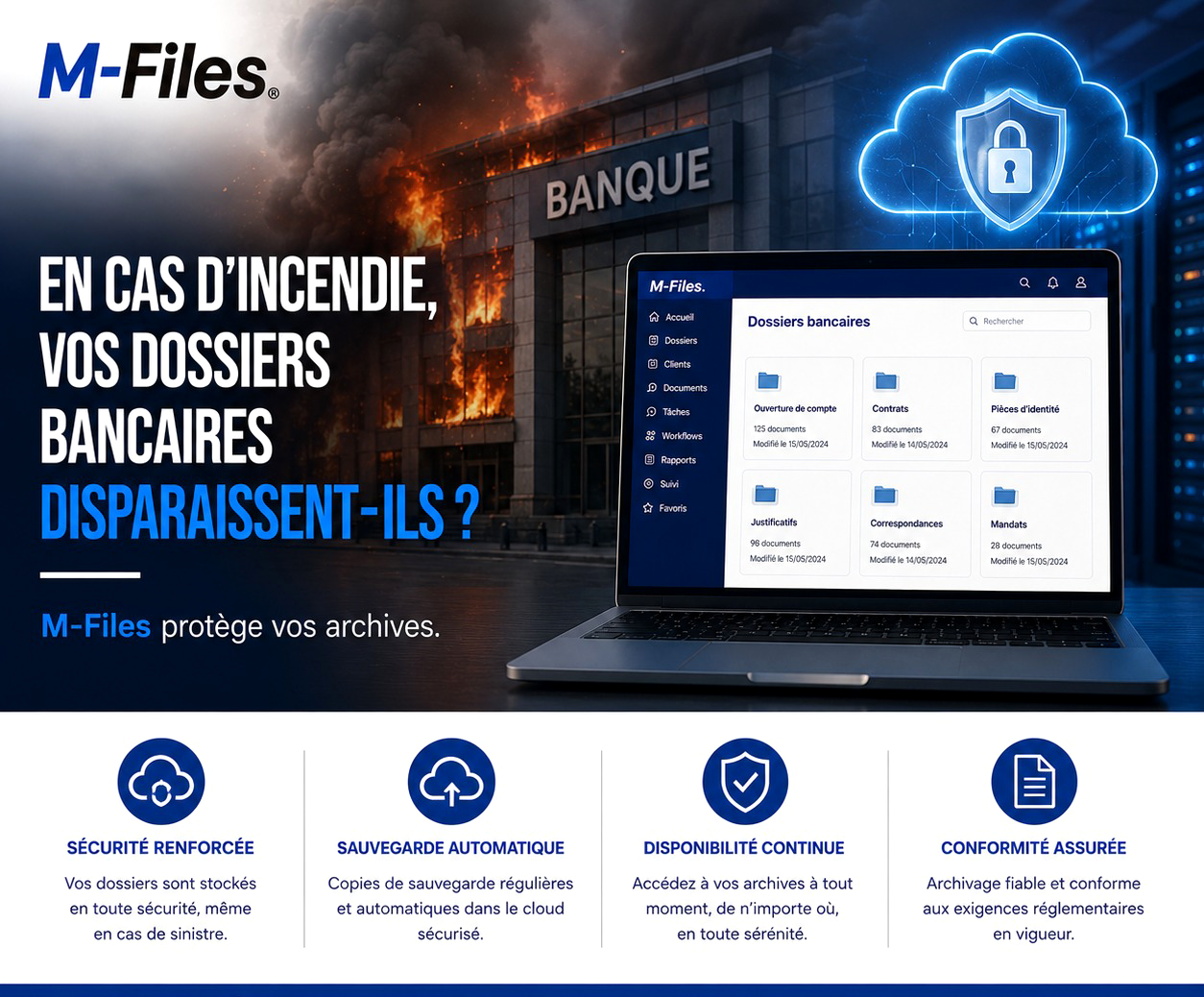
If your paper archives burned down tonight, what would be left of your clients' files? Discover how M-Files protects, backs up, and keeps your documents available, even in the event of a disaster.
Read more
A letter sits in an "to process" tray, and no one knows where it stands. Discover how M-Files centralizes, tracks and traces every piece of incoming mail, from arrival to processing.
Read more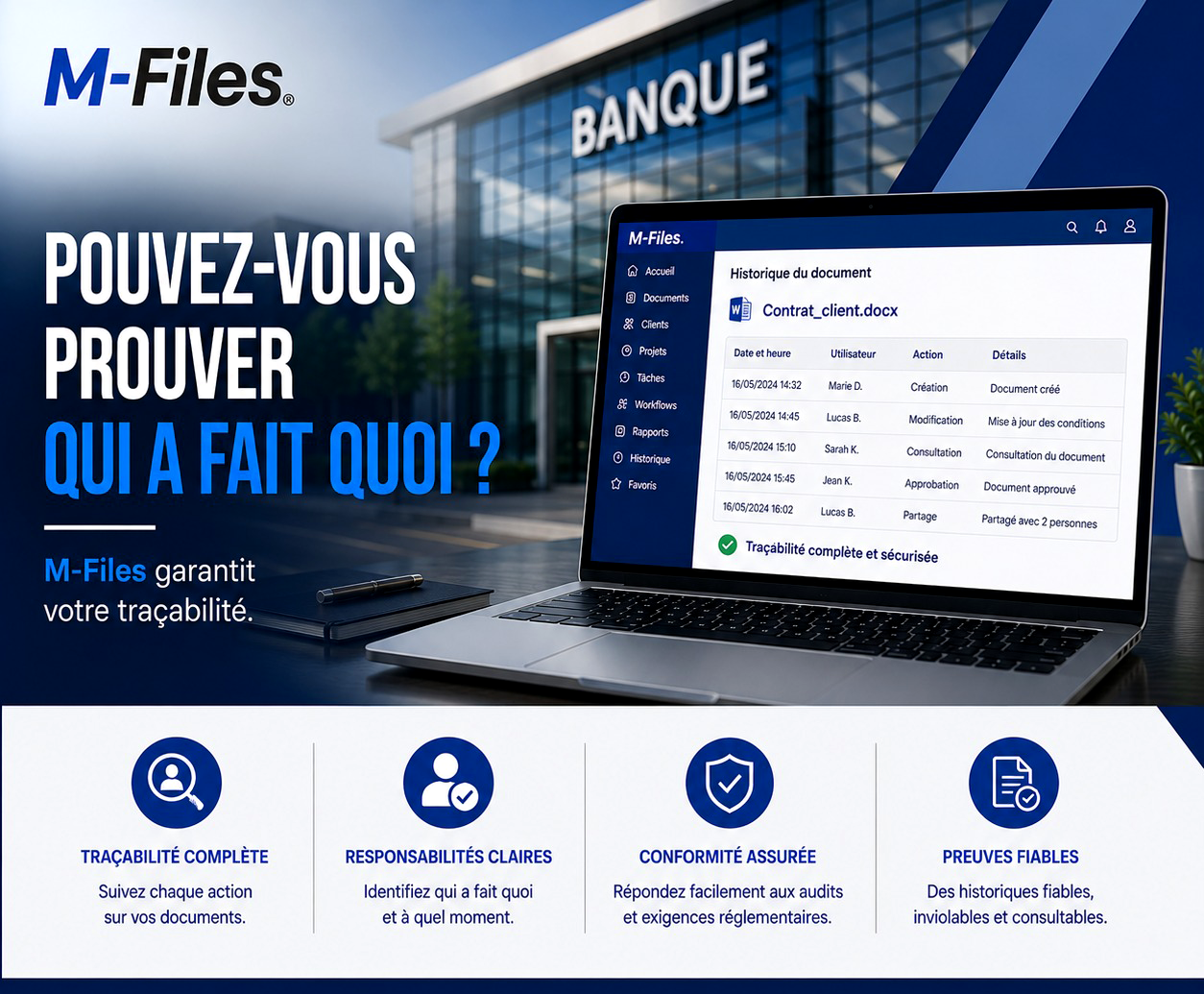
A customer disputes a charge, an auditor asks questions: can you prove who changed a document, and when? Discover how M-Files guarantees complete traceability.
Read moreContact us to learn more about our news and upcoming events.
Comments
No comments yet. Be the first to react!