
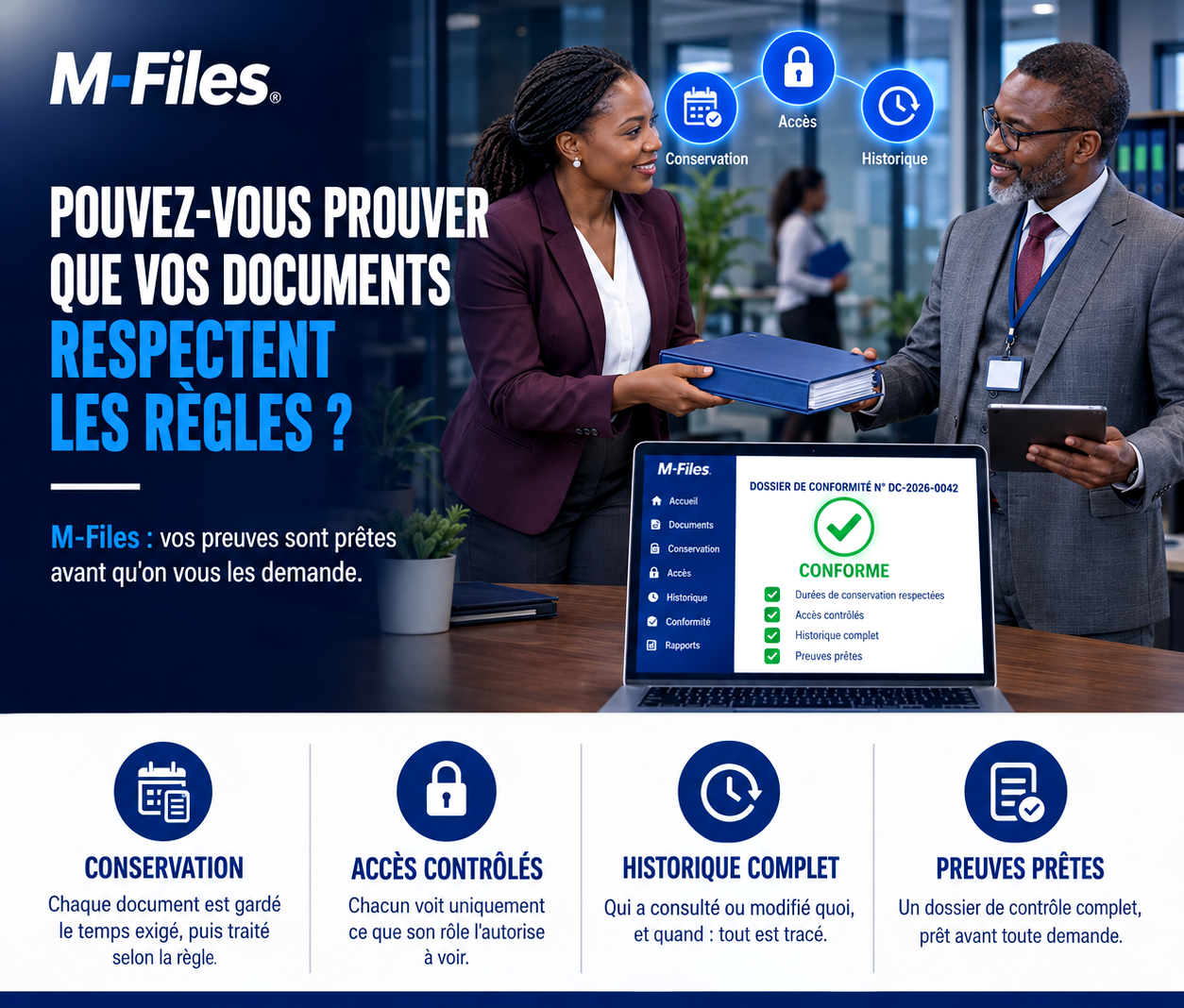
CAN YOU PROVE YOUR DOCUMENTS MEET THE RULES?
An inspection has been announced: can you prove your retention periods, access controls, and document history? Discover how M-Files prepares your evidence before anyone asks for it.
Galaxy Conseils • Banking & financial institutions sector
One Monday morning, Marie, the branch manager, receives an official letter: a regulatory inspection team will visit her branch on Thursday. The inspectors want to check three things: that documents are kept for the required retention periods, that access to client files is properly controlled, and that the bank can trace who viewed or modified what.
They also announce they will review a sample of client files. Among them, the file of Société Alpha, Aïcha's company.
Three days of racing against the clock begin. The team digs through cabinets and shared folders. Some old documents were destroyed too early, others have been kept for years for no reason. No one can say who has access to the shared client folder, or who has consulted it. In Société Alpha's file, a recent document is missing: Serge calls Aïcha urgently to ask her to resend it, the day before the inspection.
On Thursday, the inspectors leave with a list of findings: unmanaged retention periods, overly broad access rights, no traceability of who viewed what.
For the bank, it means an action plan under supervision. And for Aïcha, the uncomfortable feeling that her file wasn't as well kept as she thought.
In a bank, most teams do their best to follow the rules. The problem is that during an audit, following them isn't enough: you have to be able to prove it, quickly and document by document.
Yet proof is often the first thing missing:
Retention periods aren't tracked anywhere: everything is kept, or destroyed at random.
Access rights were assigned long ago and never reviewed.
Views and edits leave no usable trace.
Evidence has to be pulled together in a rush, right when the inspector asks for it.
The result: wasted days of work, teams under pressure, regulatory findings, and sometimes clients contacted in a panic.
The best way to pass an audit is to not have to prepare for one. When the rules are applied automatically every day — retention, access, history — the evidence already exists. All you have to do is present it.
Let's revisit Marie's story, this time in a bank that uses M-Files.
On Monday, the inspection letter arrives. Marie opens M-Files and pulls up compliance file DC-2026-0042. The status is clear: compliant.
Retention. Every document is kept for the required period based on its type, then handled according to the applicable rule. Marie can show, document type by document type, that retention periods are respected.
Controlled access. Everyone sees only what their role allows. The list of people with access to client files is up to date, and it's produced in a few clicks.
Full history. Who viewed or edited what, and when: everything is logged. For Société Alpha's file, Marie can show every view and every update since the account was opened.
Evidence ready. The audit file is complete even before the inspectors arrive. Aïcha's file is up to date: her documents were renewed on time thanks to automatic alerts.
On Thursday, Marie hands the inspectors a complete file. The inspection goes off without a hitch. And Aïcha never even finds out her file was reviewed: no one needed to call her.
Retention. Every document is kept for the required period, then handled according to the rule, automatically.
Controlled access. Everyone sees only what their role allows, and you can demonstrate it at any time.
Full history. Who viewed or edited what, and when: everything is logged, with no effort from teams.
Evidence ready. A complete audit file, ready before any request. The inspection becomes a formality.
With M-Files, compliance isn't a project launched the night before an audit. It's built into day-to-day document management: every document is classified by what it is, and retention, access, and traceability rules apply automatically based on its type.
Teams work normally, and the bank accumulates, without even thinking about it, the evidence it will need the day someone asks for it.
It's the culmination of everything we've covered in this series: traceability, a single version of the truth, data protection, archiving. Together, they give the bank something valuable: the ability to prove it.
Imagine an inspection is announced for next Thursday.
"How long would it take you to prove your retention periods, your access rights, and the history of your client files? And how many clients would you have to call in a panic?"
If that answer worries you, it's better to prepare your evidence now than in a rush.
At Galaxy Conseils, we help banks and financial institutions build compliance into their document management with M-Files, starting from their actual obligations and organization. Want to see what this would look like at your bank?
Galaxy Conseils: innovation at the service of your performance.
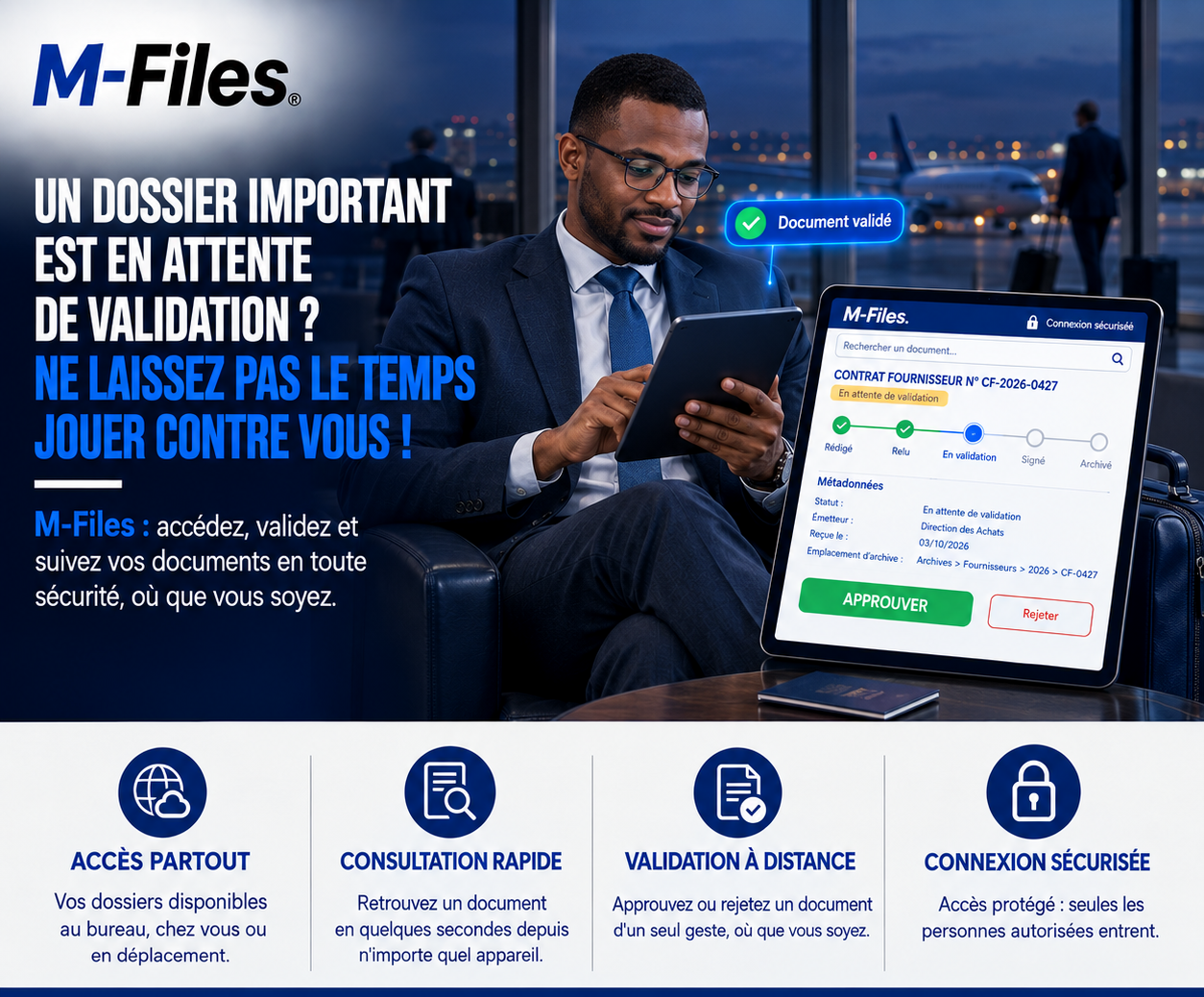
A supplier contract is waiting on a traveling director's signature, and the offer is about to expire? Discover how M-Files lets you access, approve, and track your documents securely, wherever you are.
Read more
Analyst, lawyer, advisor: is the whole team working from the right version? Discover how M-Files brings every client or project file together in one place, up to date for everyone.
Read more
A manager travels, and everything grinds to a halt? Discover how M-Files lets you find, review, and approve your documents from a computer or phone, safely and securely.
Read moreContact us to learn more about our news and upcoming events.
Our offers, news and document management tips, straight to your inbox. One e-mail a month at most.
Unsubscribe in one click at any time. Privacy policy
Check your inbox
We've sent you a confirmation link. Click it to complete your sign-up.
Comments
No comments yet. Be the first to react!