
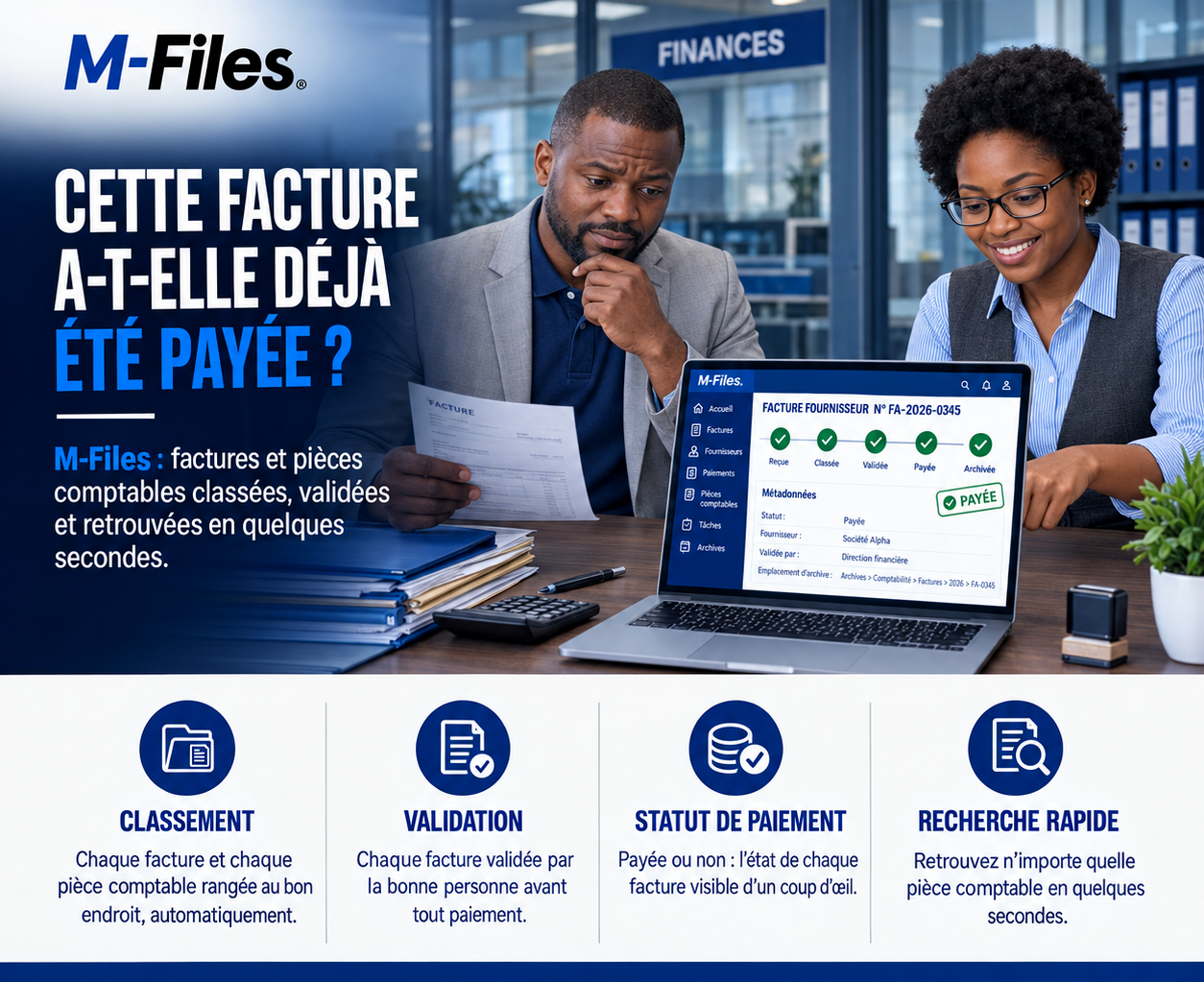
HAS THIS INVOICE ALREADY BEEN PAID?
Has this invoice already been paid? Duplicate invoices, late supplier payments, missing accounting documents: discover how M-Files classifies, validates, and tracks every invoice.
Galaxy Conseils • Banking & financial institutions sector
All thirty branches are equipped. Aïcha sends the bank her invoice for the installation, reference FA-2026-0345: one by email to the Purchasing Department, another on paper to the mail office, as required by the contract.
Weeks go by. No payment. For a small business like Société Alpha, that's a significant amount : Aïcha has to pay her own suppliers and employees. After two months, she sends a reminder, with a new copy of the invoice.
At the bank, the paper invoice had been logged at the mail office, then forwarded to accounting. The email version, meanwhile, was waiting for approval from the Finance Department in an inbox. And the copy attached to the reminder arrives in accounting in turn, as if it were a new invoice.
No one connects the three. The invoice is eventually approved... then paid twice.
It takes the year-end audit to uncover the mistake. Aïcha, being honest, immediately refunds the overpayment. But the bank had to explain the anomaly to its auditors, and Aïcha is left with a bitter memory of those two months without being paid.
A supplier invoice seems simple. Yet between receipt and payment, it passes through several hands: mail, purchasing, accounting, finance. And when it arrives through several channels at once (paper, email, reminder), the risks multiply:
Duplicate invoices, logged multiple times because they arrived through different channels.
Forgotten invoices, sitting unapproved in an inbox or on a desk.
No visibility on status: unable to quickly answer a supplier asking about their payment.
Missing accounting documents at audit time: the invoice, purchase order, and contract aren't filed together.
For the bank, it's a financial risk and a source of audit findings. For suppliers, often small businesses, it strains their cash flow.
To avoid these mistakes, every invoice should exist only once, linked to its supplier and its contract, and follow a clear path: received, filed, approved, paid, archived. At any moment, everyone should be able to see where it stands.
Let's revisit Aïcha's story, this time in a bank that uses M-Files.
Received. Invoice FA-2026-0345 arrives by email and by mail. It's logged once in M-Files, with its metadata: number, supplier (Société Alpha), amount, date.
Filed. It's automatically filed in the right place and linked to the supplier contract and the delivery notes from all thirty branches. Every related document is brought together.
Approved. The invoice is sent to the Finance Department, which approves it in a few clicks, from their desk or their phone.
Paid. Once payment is made, its status changes to "Paid." It's visible at a glance to everyone who needs it.
Archived. The invoice and all its related documents are archived under Archives > Accounting > Invoices > 2026 > FA-0345.
And if Aïcha's reminder arrives with a new copy? The accounting team searches for reference FA-2026-0345 and immediately sees it already exists, was approved, and has been paid. The copy isn't logged a second time.
Aïcha is paid within the deadlines set by the contract. At the year-end audit, accounting presents every document in seconds. And no one wonders anymore whether this invoice has already been paid.
Filing. Every invoice and every accounting document is filed in the right place, automatically, and linked to its supplier and its contract.
Approval. Every invoice is approved by the right person before any payment. No more unchecked payments, no more forgotten invoices.
Payment status. Paid or not: the status of every invoice is visible at a glance. You answer your suppliers in seconds.
Fast search. You find any accounting document in seconds, by number, supplier, amount, or date.
M-Files doesn't replace the accounting software that executes payments. It handles everything around it: receiving invoices, filing them, linking them to contracts and purchase orders, approving them, and archiving them.
Every invoice becomes a single document, linked to everything related to it, with a visible status at every step. Duplicates are easy to spot, so are delays, and auditors find what they're looking for without waiting.
And because every supplier has their own file, the bank sees its entire relationship with them at a glance: contracts, invoices, payments, and correspondence.
Ask your accounting team:
"How many supplier invoices are waiting for approval today? Since when? And can you be certain none has been paid twice this year?"
If the answer takes several days of checking, your invoices deserve better tracking.
At Galaxy Conseils, we help banks and financial institutions take control of their invoice and accounting document workflow with M-Files, starting from their actual approval processes. Want to see what this would look like at your bank?
Galaxy Conseils: innovation at the service of your performance.
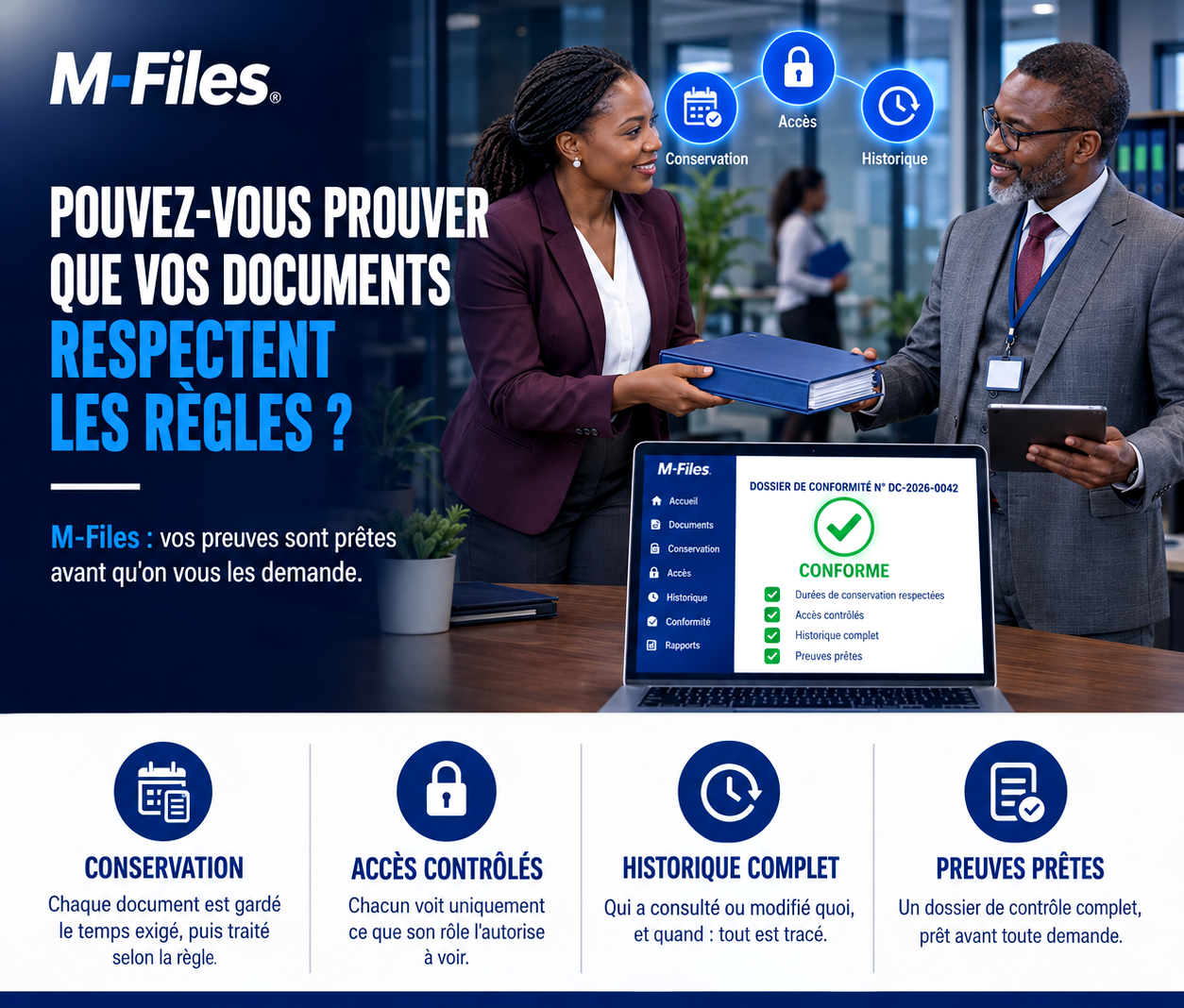
An inspection has been announced: can you prove your retention periods, access controls, and document history? Discover how M-Files prepares your evidence before anyone asks for it. Contenu
Read more
A supplier contract is waiting on a traveling director's signature, and the offer is about to expire? Discover how M-Files lets you access, approve, and track your documents securely, wherever you are.
Read more
Analyst, lawyer, advisor: is the whole team working from the right version? Discover how M-Files brings every client or project file together in one place, up to date for everyone.
Read moreContact us to learn more about our news and upcoming events.
Our offers, news and document management tips, straight to your inbox. One e-mail a month at most.
Unsubscribe in one click at any time. Privacy policy
Check your inbox
We've sent you a confirmation link. Click it to complete your sign-up.
Comments
No comments yet. Be the first to react!