
Banking & Finance
What if your customers could open a bank account more easily?
Insights — Galaxy Conseils · 4 min read
Tuesday morning, 10am. Aïcha walks into a bank branch. She just landed a new job, and her employer needs an account to pay her salary into. She figures it'll be quick.
At the counter, she's handed a list of documents to provide: proof of ID, proof of address, employment certificate, photos... She's brought some of them. She leaves and comes back the next day with the rest.
The advisor photocopies, staples, and files everything into a tray. "We'll call you as soon as it's approved."
A week goes by. Then a second one. Aïcha calls the branch, and no one really knows where her file stands. Maybe it's waiting on a signature. Maybe a document is missing. Maybe it even ended up with the wrong department.
Meanwhile, a friend tells her about another bank, "where everything moved really fast." Aïcha doesn't have her account yet, but she's already thinking about leaving.
Many banks know this scene well. And the most striking part is that no one made a mistake: the advisor was courteous, the manager will approve the file as soon as they see it, and the compliance team is doing its job.
The problem is the journey itself.
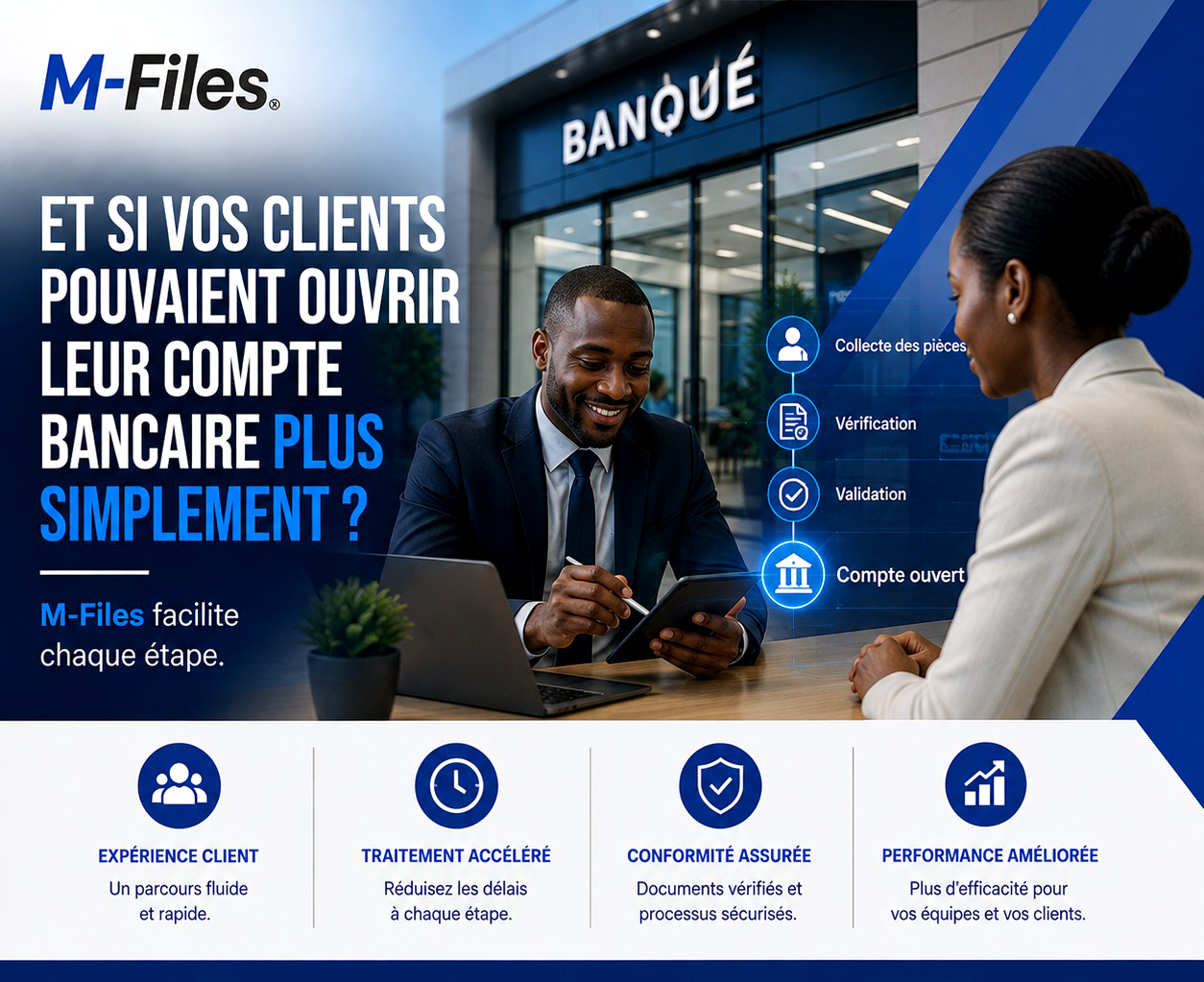
A traditional account opening relies on a chain of manual steps: collecting documents, checking them, getting them approved, then opening the account. Each step assumes a paper file passes from one hand to another. And that's exactly where things get complicated:
For the customer, it all comes down to one impression: it's slow, and it's complicated.
It's easy to forget, but opening an account is the very first moment of the relationship between a bank and its customer. It's where they form an idea of how they'll be treated for years to come.
A smooth journey tells the customer: "Here, we respect your time." A clunky one tells them the opposite, before they've even made their first transaction.
In an industry where customers compare more and more, simplicity is no longer a bonus. It's a competitive advantage.
Let's replay Aïcha's story, this time at a bank using M-Files.
Four smooth steps, with no file lost along the way and no calls needed to check where the request stands.
A better customer experience. The journey is simpler and faster, and the customer leaves with a good impression from day one. That's often what makes the difference between a customer who stays and one who leaves.
Faster processing. When files automatically flow to the right person, nothing stays stuck on a desk. Turnaround times drop at every step.
Guaranteed compliance. Regulatory requirements, particularly Know Your Customer (KYC) and anti-money-laundering rules, require verifying and retaining specific documents. With M-Files, every document is verified, every action is traced, and every file is archived according to clear rules. Facing an audit, the bank presents complete files, with no last-minute scrambling.
More productive teams. Advisors spend less time hunting for documents and chasing colleagues, and more time doing what actually matters: advising their customers.
Most tools classify documents by where they're stored, in a folder or subfolder. M-Files classifies them by what they are: a proof of ID, a supporting document, a contract, all attached to a specific client.
This approach changes everything. A document is never "somewhere" again: it's linked to its client, its file, and its stage in the process. You find it in seconds, in the right version, with the full history of everything that's been done.
And what applies to account opening also applies to credit applications, updating client files, or handling complaints. Every document-driven process at a bank can benefit.
Ask yourself a simple question: how long does it take today, at your institution, between the moment a customer hands over their documents and the moment their account is opened?
And how many customers, like Aïcha, gave up along the way without anyone noticing?
If the answer makes you uneasy, it's probably the right time to rethink your process.
At Galaxy Conseils, we help banks and financial institutions simplify their customer journeys with M-Files. We don't impose a standard template — we start from your actual processes.
Galaxy Conseils: innovation in service of your performance.
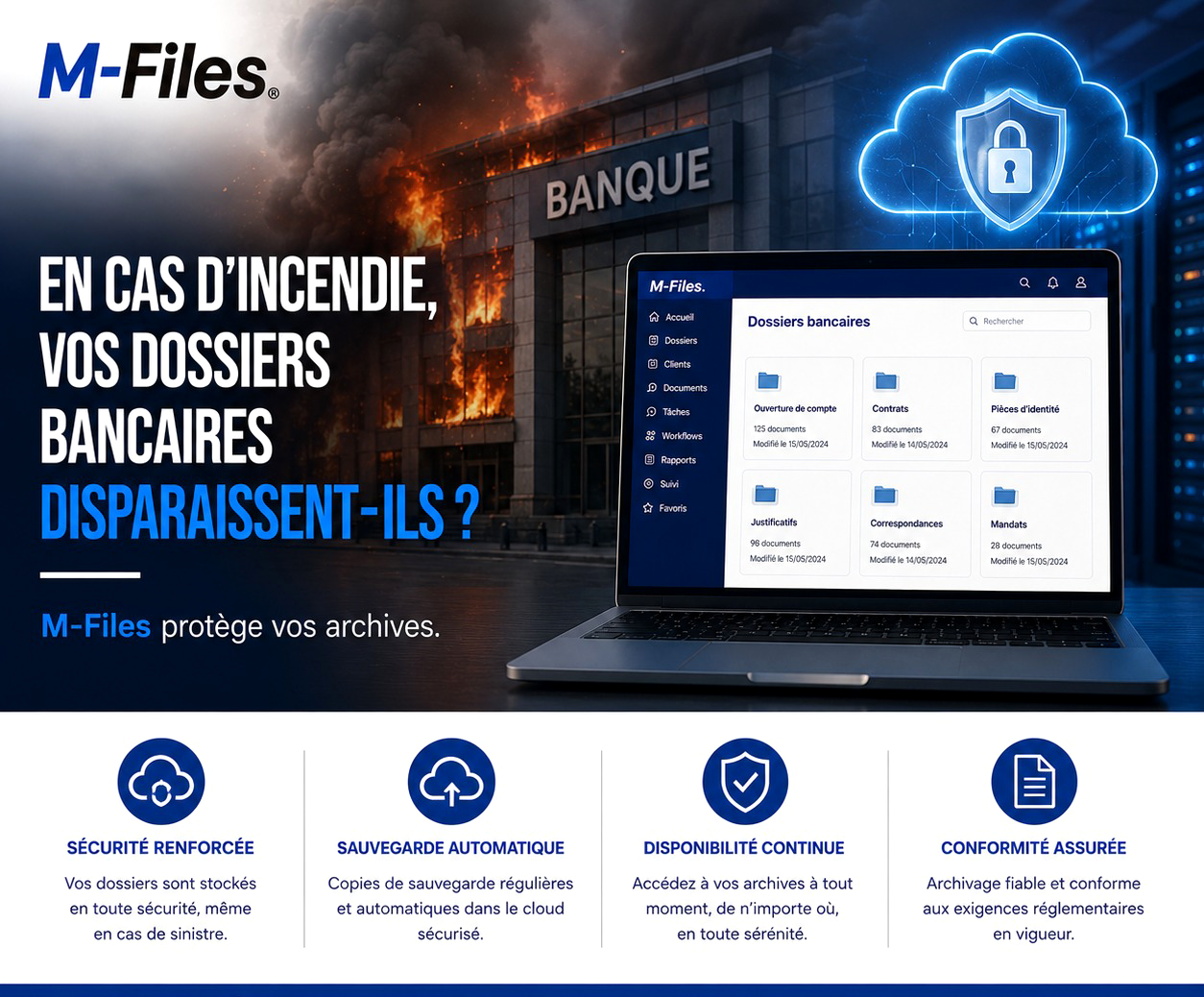
If your paper archives burned down tonight, what would be left of your clients' files? Discover how M-Files protects, backs up, and keeps your documents available, even in the event of a disaster.
Read more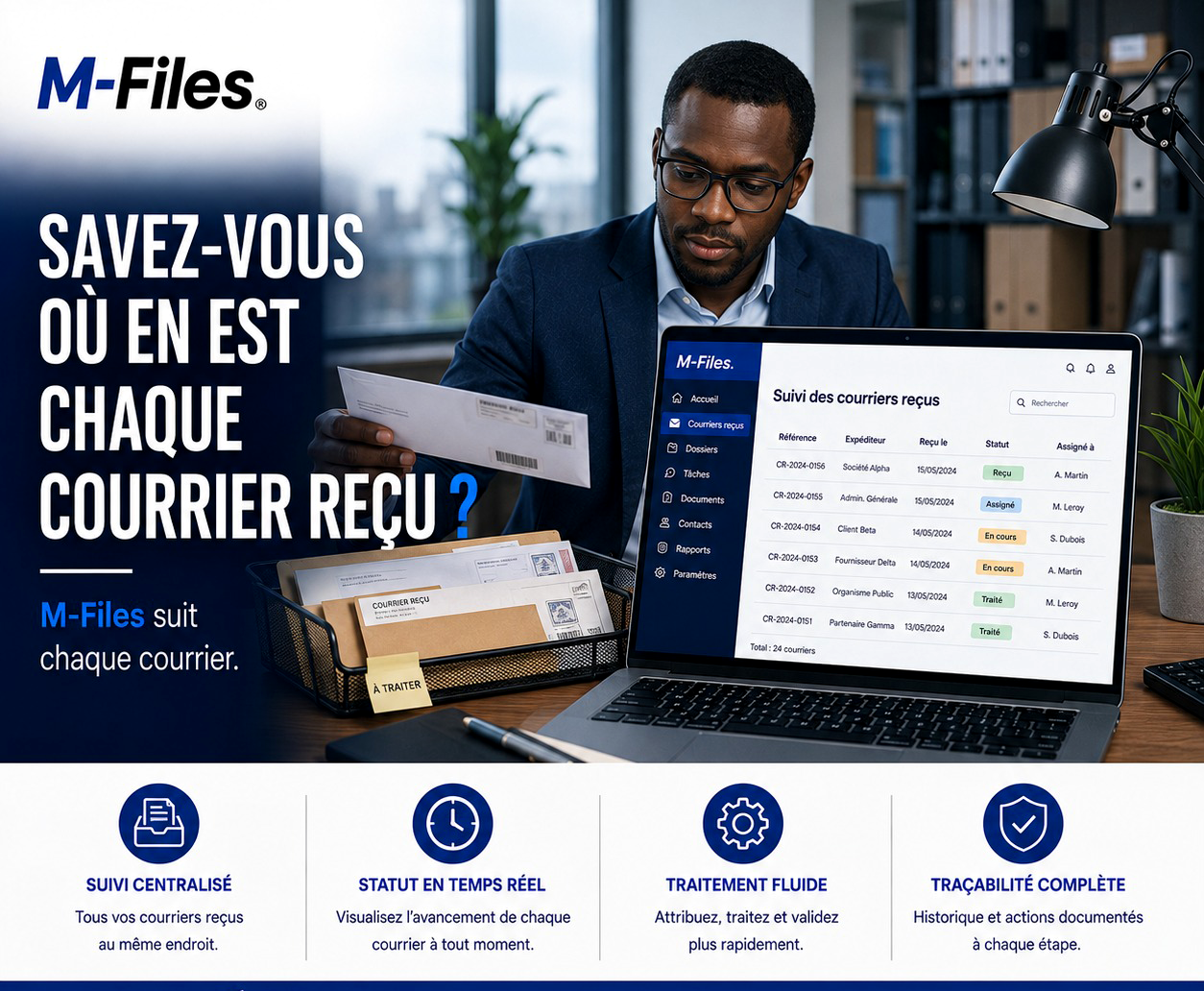
A letter sits in an "to process" tray, and no one knows where it stands. Discover how M-Files centralizes, tracks and traces every piece of incoming mail, from arrival to processing.
Read more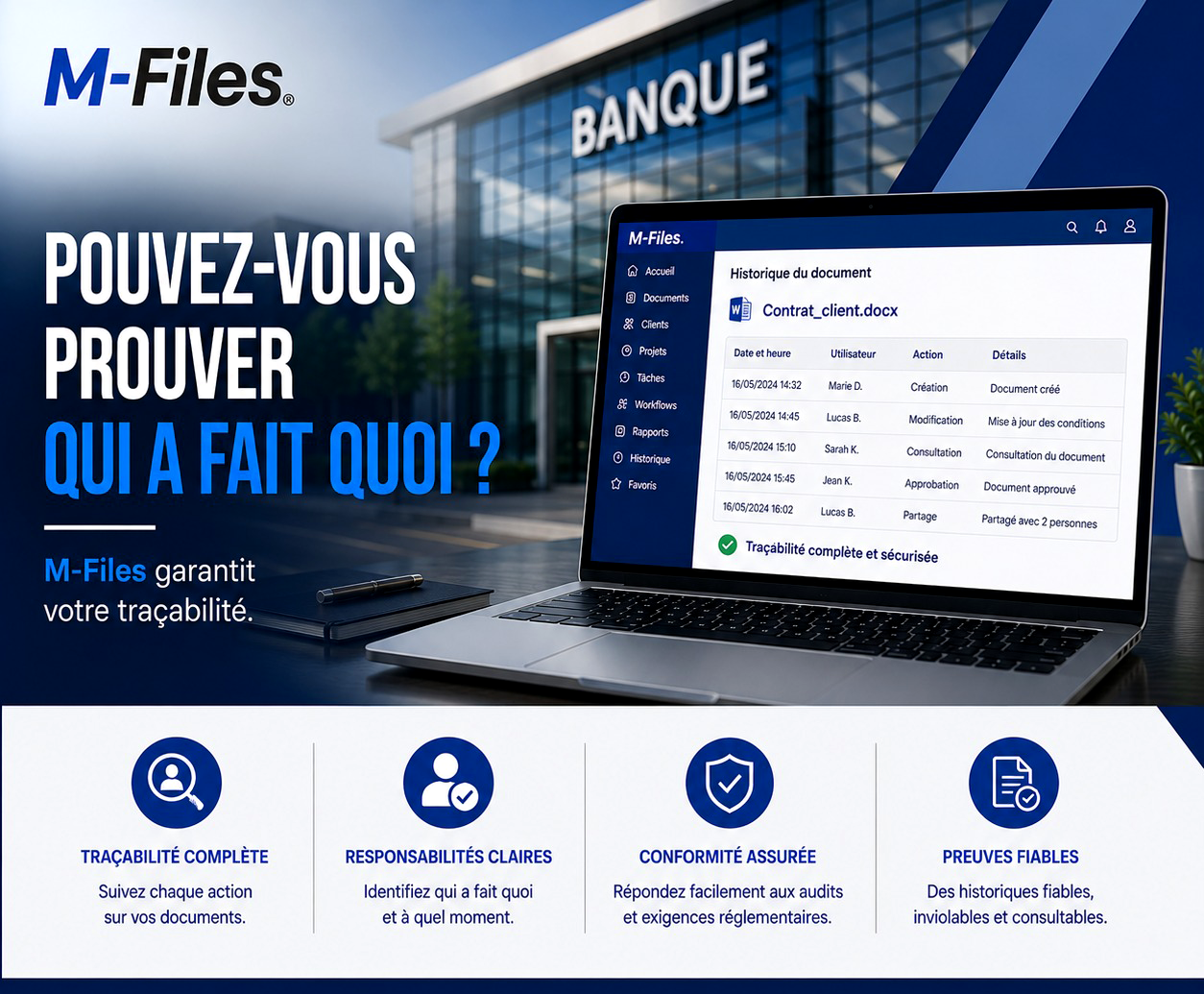
A customer disputes a charge, an auditor asks questions: can you prove who changed a document, and when? Discover how M-Files guarantees complete traceability.
Read moreContact us to learn more about our news and upcoming events.