
Banking & Finance
Can you prove who did what?
Insights — Galaxy Conseils · 4 min read
Remember Aïcha? She eventually opened her account. A few months later, she even signed a credit contract to buy a car. Everything was going fine.
Until that morning.
While checking her statement, Aïcha finds charges she doesn't recognize. She pulls out her copy of the contract: the terms don't match. She heads to the branch, document in hand.
"Who changed the terms of my contract? And when?"
The advisor opens the shared folder. There are three files: "Contract_Aicha.docx," "Contract_Aicha_v2.docx," and "Contract_Aicha_final_OK.docx." Which one was signed? Who made the last change? The file only shows a saved date. Nothing more.
The advisor calls a colleague, who calls another. No one remembers. No one can prove anything.
Aïcha leaves without an answer. And with one certainty: this bank doesn't have control over its own documents.
In this story, it may have simply been a data-entry error. The charges might even be justified. But without proof, the bank can neither defend itself, nor correct the mistake, nor reassure its customer.
That's the trap of documents managed in shared folders, emails, or filing cabinets:
In a bank, this grey area is costly: disputes with customers, auditor findings, compliance risk, and above all, lost trust.
A customer entrusts their bank with their money, their personal information, and their plans. In return, they expect one simple thing: that everything is done correctly, and that it can be proven to them.
Regulators expect the same. During an inspection, the question isn't just whether a document exists. It's who created it, who changed it, who approved it, and when.
"We think that..." isn't a good enough answer. You need to be able to show it.
Let's replay Aïcha's story, this time at a bank using M-Files.
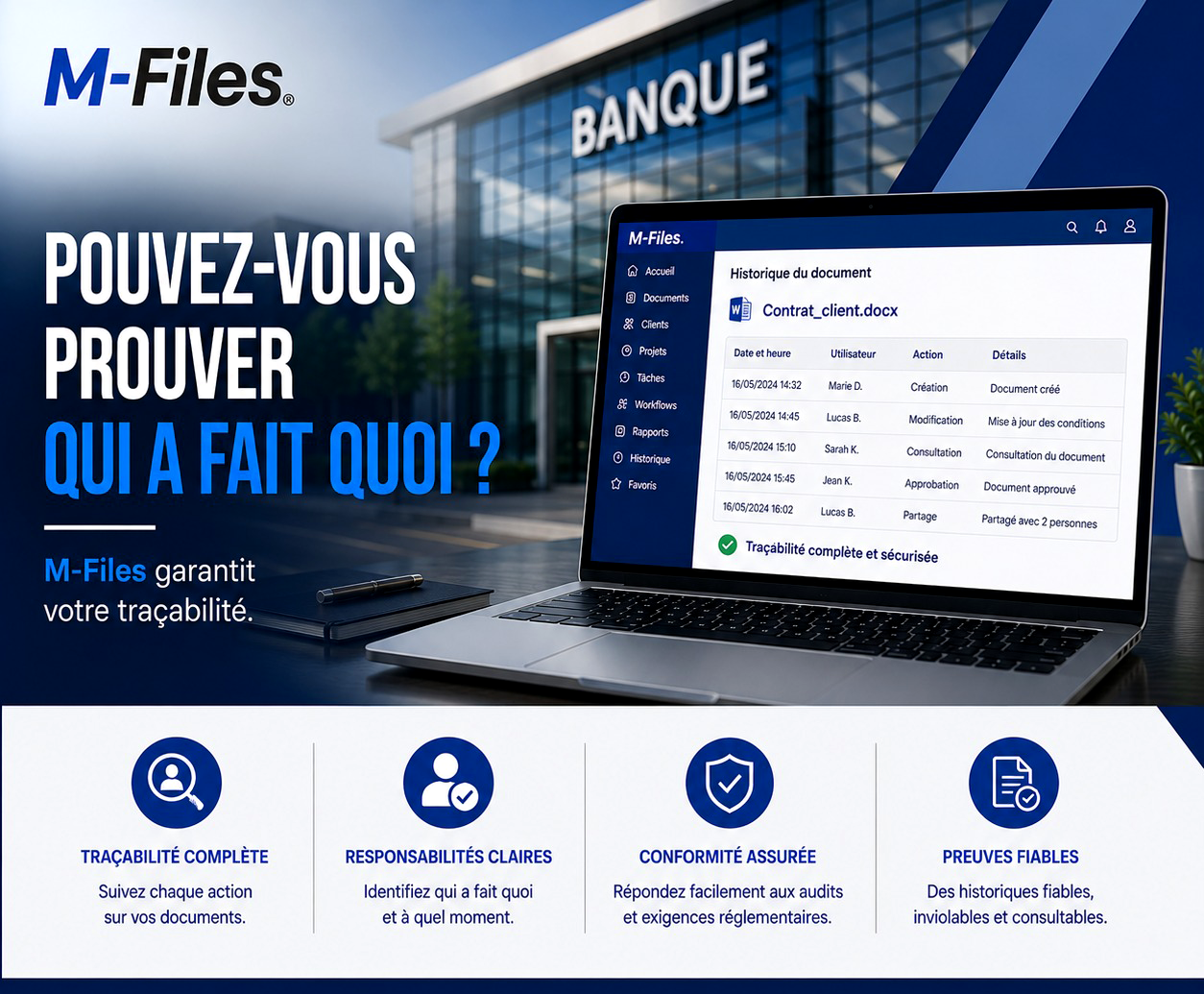
Aïcha arrives at the branch with her question. The advisor finds her contract in seconds, then opens its history. It's all there, line by line:
| 2:32pm | Marie D. creates the document. |
| 2:45pm | Lucas B. changes the terms. |
| 3:10pm | Sarah K. reviews the document. |
| 3:45pm | Jean K. approves the document. |
| 4:02pm | Lucas B. shares it with two people. |
In two minutes, the advisor knows exactly what happened. He can show Aïcha the version she actually signed, identify the change that was made and, if needed, resolve it with the right person.
Aïcha leaves reassured. Not because she was given a promise, but because she was given proof.
Complete traceability. Every action on a document is logged automatically: creation, editing, viewing, approval, sharing. Nothing depends on anyone's memory or goodwill.
Clear accountability. You know who did what, and when. Everyone owns their role, and mistakes get corrected quickly because you know where they came from.
Guaranteed compliance. Facing an auditor or a regulator, the bank presents a precise history instead of scrambling to reconstruct the facts. Regulatory requirements become a formality rather than a source of stress.
Reliable evidence. Histories are stored securely, available at any time, and impossible to rewrite after the fact. In case of a dispute, the bank has solid grounds to stand on.
With M-Files, a document isn't just a file sitting in a folder. It's a living object, with an identity, an owner, access rights, and a memory.
Every time someone opens, edits, or approves it, M-Files logs it, with nothing extra for anyone to do. There is only ever one official version of the document, and every previous version stays available to view.
What applies to a credit contract also applies to account-opening files, meeting minutes, internal procedures, or supporting documents. Wherever proof matters, M-Files guarantees it.
Imagine a customer, an auditor, or your own management asking you this question tomorrow:
"Who changed this document, and when?"
How long would it take you to answer? And would you be able to prove it? If the answer makes you hesitate, it's the right time to act.
At Galaxy Conseils, we help banks and financial institutions secure their documents and guarantee their traceability with M-Files. We start from your actual processes, not a standard template.
Galaxy Conseils: innovation in service of your performance.
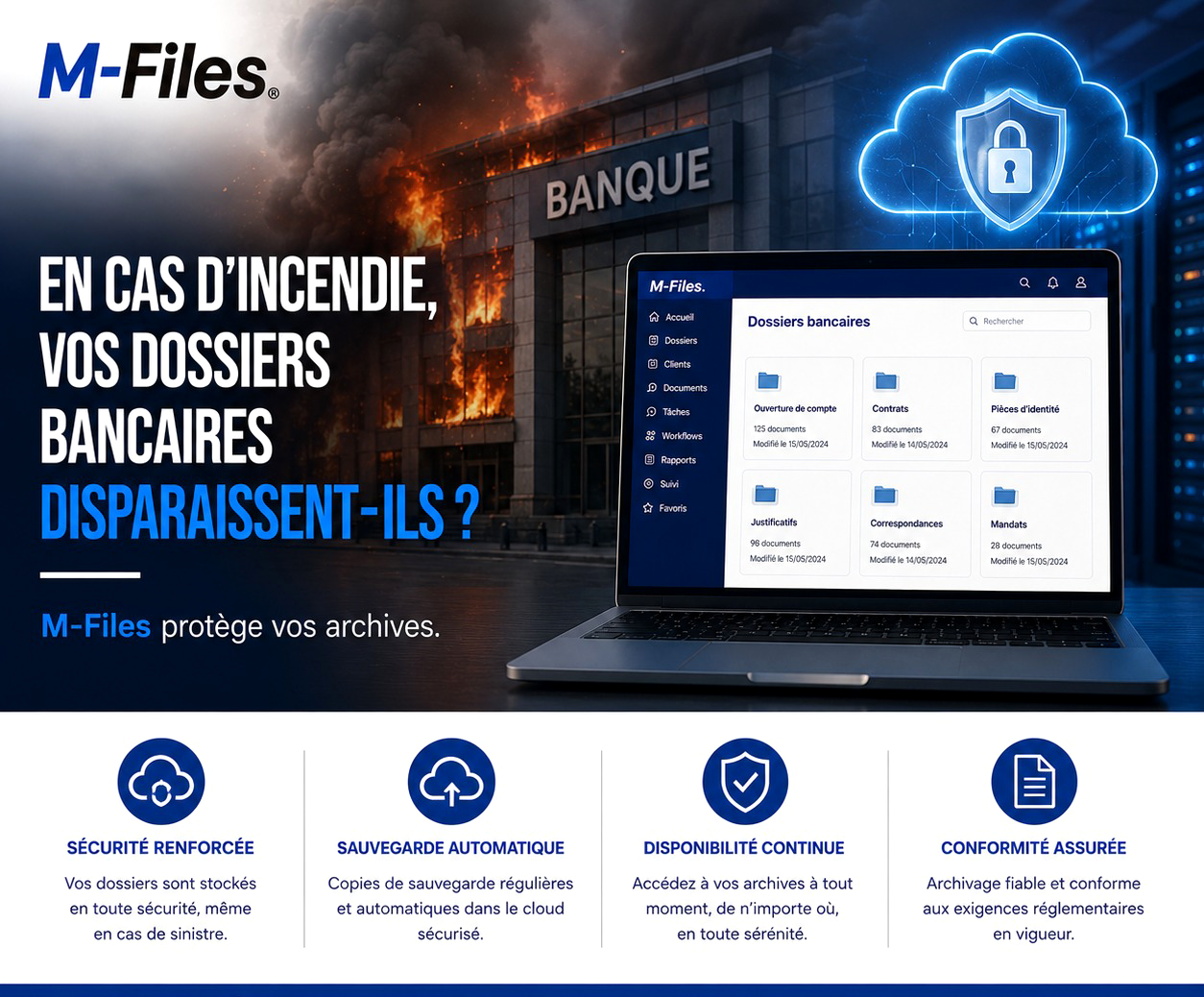
If your paper archives burned down tonight, what would be left of your clients' files? Discover how M-Files protects, backs up, and keeps your documents available, even in the event of a disaster.
Read more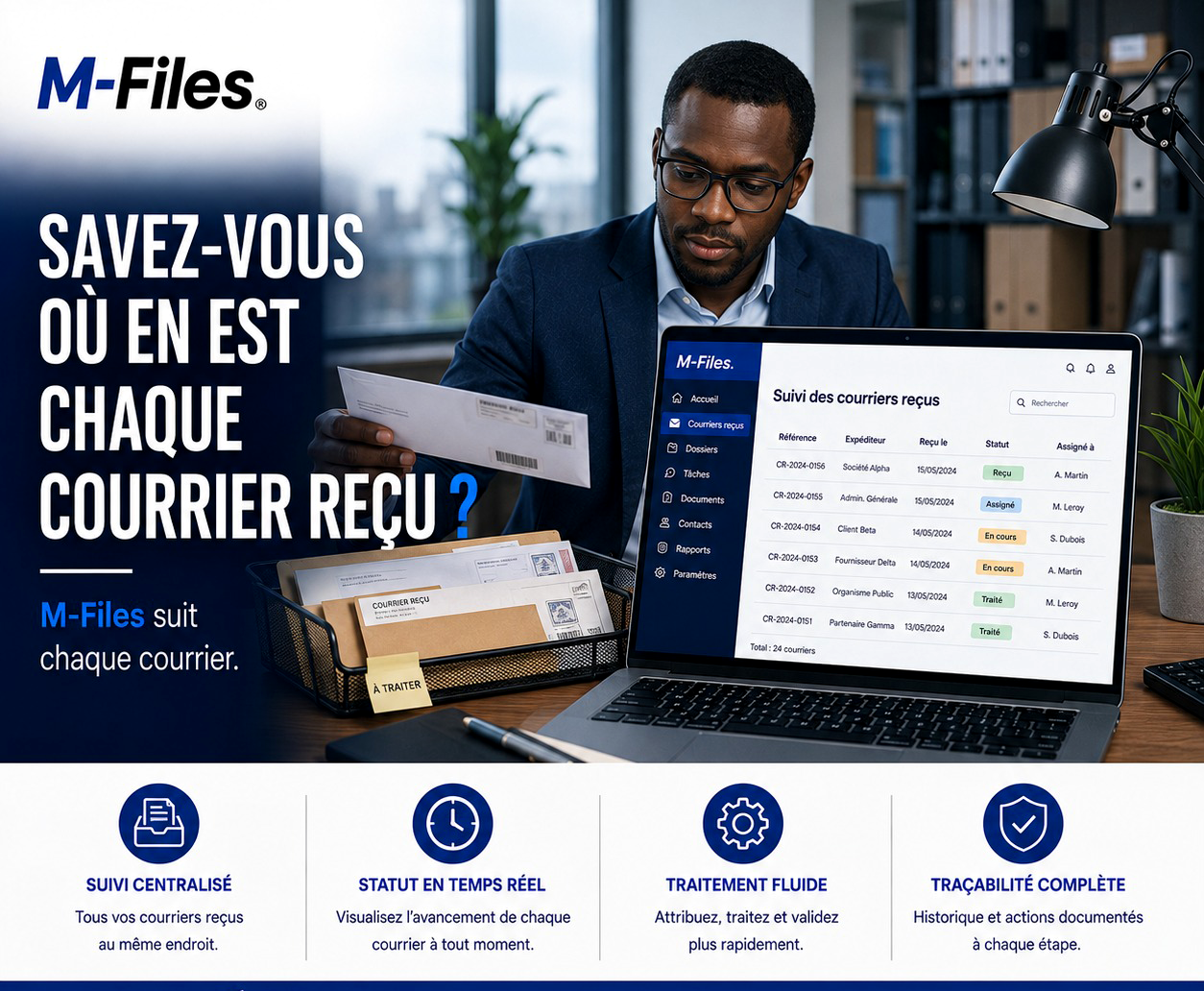
A letter sits in an "to process" tray, and no one knows where it stands. Discover how M-Files centralizes, tracks and traces every piece of incoming mail, from arrival to processing.
Read more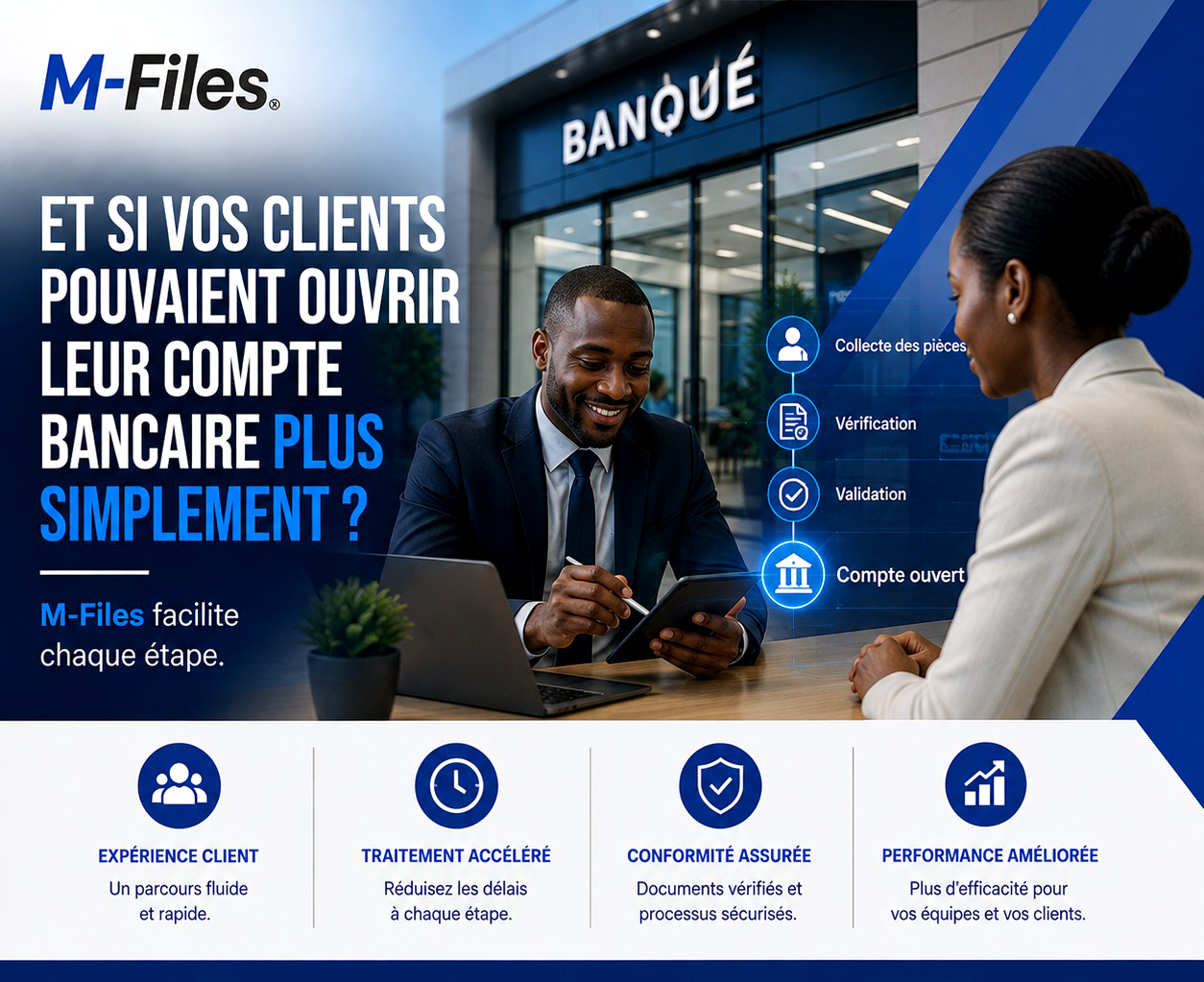
Missing documents, stalled files, customers left waiting... Discover how M-Files makes opening a bank account faster, smoother and compliant.
Read moreContact us to learn more about our news and upcoming events.