
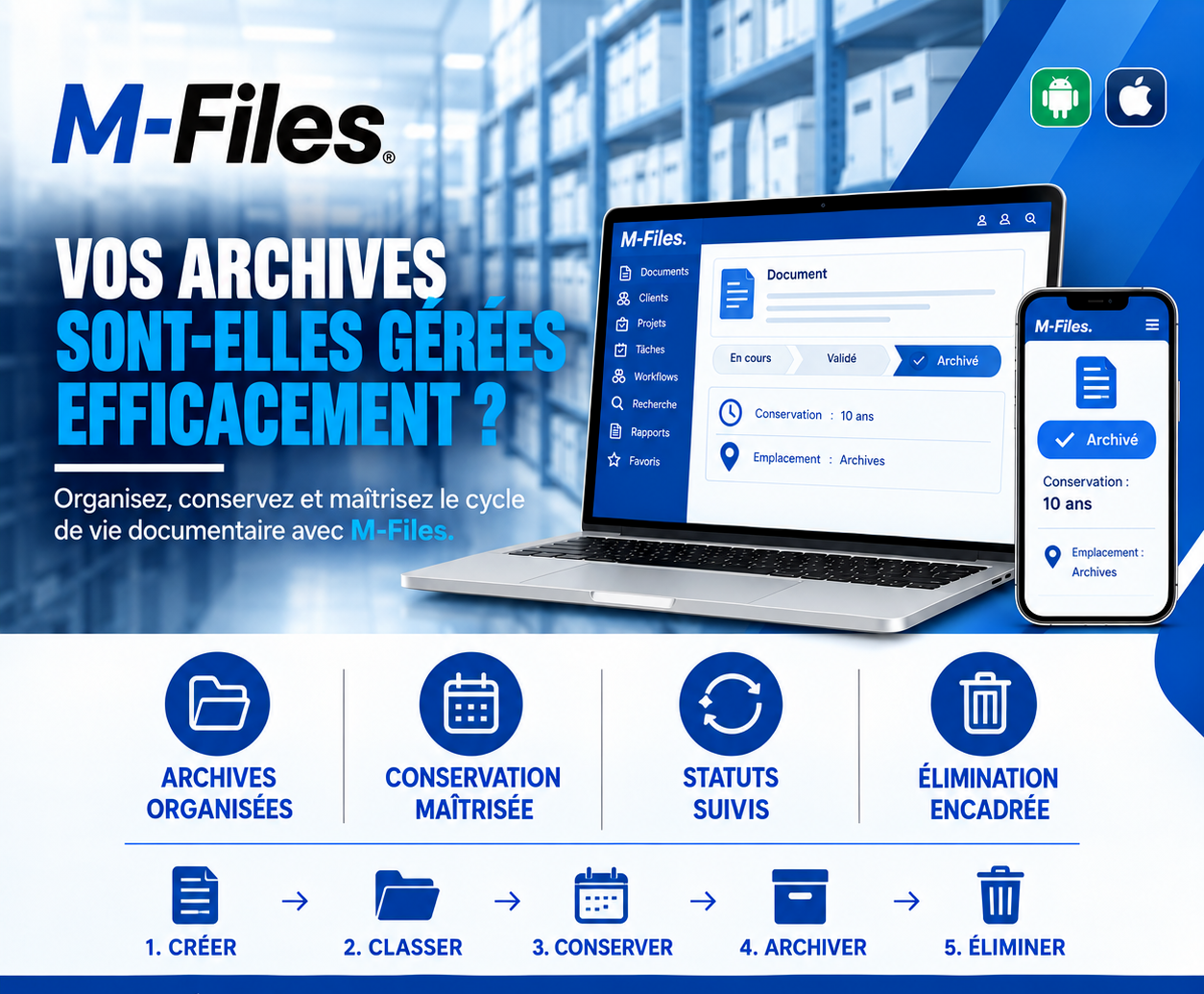
ARE YOUR ARCHIVES MANAGED EFFICIENTLY?
Organized archives, controlled retention, tracked statuses, supervised disposal: see how M-Files manages your documents' lifecycle.
Galaxy Conseils • Banking & financial institutions sector
To make room, the branch decides on a major sort-through of its archive room. The instruction is simple: "Anything over ten years old goes for destruction." The boxes are sorted in a single weekend, based on the dates scrawled in marker on their labels. Dozens go to the shredder.
Among them, a box labeled "Commitments 2014-2015." It held the collateral documents for an old Société Alpha loan, repaid long ago. Nobody thought it would still be needed.
Six months later, Aïcha wants to sell a piece of land that had served as collateral for that loan. The notary asks for proof that the lien was duly released. At the bank, they search. The box has been destroyed. The evidence has to be reconstructed from other sources, over several weeks.
Meanwhile, the archive room is still overflowing, because other boxes have been kept "just in case" for twenty years. What should have been kept was destroyed, and what could have been disposed of was kept.
A well-managed archive is neither a warehouse where everything is kept indefinitely, nor a room that gets cleared out from time to time by guesswork. It's a controlled lifecycle: every document is created, used, retained for a defined period, then archived or disposed of according to clear rules.
These retention periods aren't arbitrary. Some are set by regulation: in the OHADA zone, for instance, accounting documents and supporting records must be kept for ten years. Others stem from banking regulation, legal caution, or internal policy. Without rules applied document by document, mistakes are inevitable.
Destroyed too soon — a document still useful, or still legally required, disappears.
Kept too long — archives overflow, and personal data is retained longer than necessary.
Unknown statuses — nobody knows whether a document is in progress, validated, or archived.
Disposal with no trace — impossible to prove what was destroyed, when, or on whose decision.
The solution is to define, for each document type, a retention period and what should happen once it expires. The system then applies these rules automatically, accounting for exceptions — for example, a document tied to an ongoing dispute or a still-active guarantee.
Let's replay the story, this time at a bank that manages its documents' lifecycle with M-Files.
1. Create. Every document is registered with its type: loan contract, collateral deed, accounting record, correspondence.
2. Classify. It's linked to its client, here Société Alpha, and to its file. Its status evolves: "In progress," then "Validated."
3. Retain. Depending on its type, it receives a retention period, for example "10 years" for an accounting record. The starting point can be a specific date, such as the end of the loan or the release of the guarantee.
4. Archive. At the end of the loan, the file moves to "Archived" status. Its location is known, "Archives," for both the digital version and the paper original.
5. Dispose. At expiry, M-Files doesn't destroy anything on its own: it flags documents that have reached term. The archives manager checks, legal validates, and the disposal is logged.
During the sort-through, Société Alpha's guarantee-release deed appears with a clear rule: it must be kept as long as acts related to the property might need it. So it stays in the archives. Documents that have genuinely reached term are disposed of, with a record of the decision.
When Aïcha's notary asks for proof the guarantee was released, the bank sends it the same day. The land sale closes without delay. And the archive room has finally found some room.
1 Create · 2 Classify · 3 Retain
4 Archive · 5 Dispose (with validation)
Organized archives. Every document has a type, a client, a status and a known location.
Controlled retention. Each document type has its own retention period, applied automatically.
Tracked statuses. In progress, validated, archived: you know at any time where each document stands.
Supervised disposal. Nothing is destroyed without a rule, without approval, and without a trace.
In M-Files, the retention period isn't scrawled in marker on a box: it's attached to the document, based on its type and its information. Workflows move the document's status forward throughout its life, and at expiry can trigger a review task rather than automatic destruction.
Exceptions are handled: a document tied to a dispute or to a still-active guarantee can be protected from disposal for as long as the situation justifies it. And every archiving or disposal decision is recorded in the history.
This also covers paper: M-Files can indicate where the physical original of a document is located, so retention rules apply to the boxes too.
Ask yourself:
"Do you know, for every document type at your bank, how long it must be kept, and who decides when it's destroyed?"
If the answer is unclear, your archives deserve a real lifecycle policy.
At Galaxy Conseils, we help banks and financial institutions define their retention rules and apply them in M-Files, working with their legal and compliance teams. Want to see concretely what this would look like at your bank?
Galaxy Conseils: innovation serving your performance.
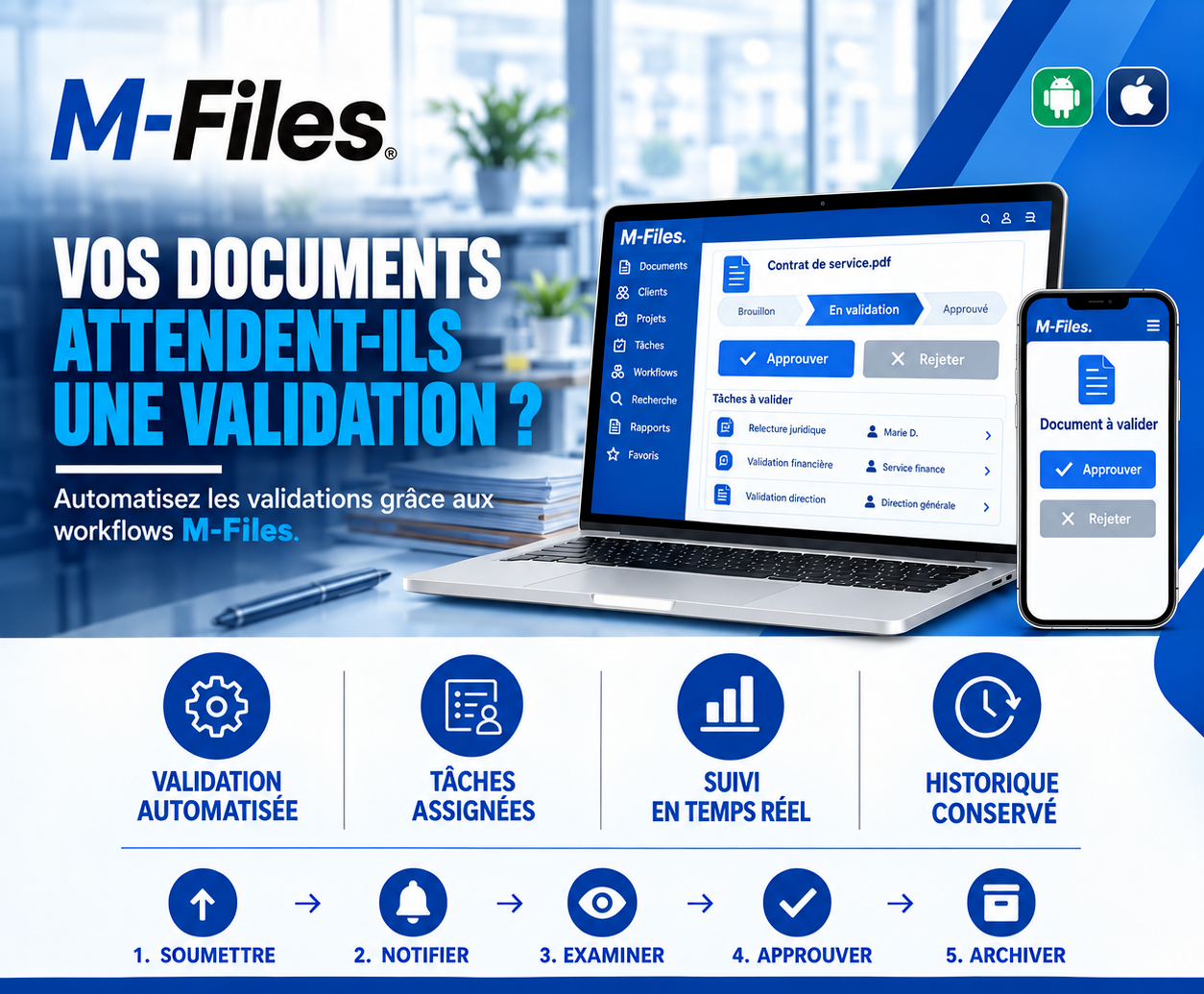
Are your documents waiting for approval? Automated validation, assigned tasks, real-time tracking, kept history: see how M-Files workflows speed up your approvals.
Read more
Can you access your documents outside the office? Access everywhere, on computer and mobile, synchronized documents, secure access: see how M-Files supports your teams in the field.
Read more
Who can view your confidential documents? Controlled access, role-based rights, protected documents, tracked views: discover how M-Files protects your sensitive records.
Read moreContact us to learn more about our news and upcoming events.
Our offers, news and document management tips, straight to your inbox. One e-mail a month at most.
Unsubscribe in one click at any time. Privacy policy
Check your inbox
We've sent you a confirmation link. Click it to complete your sign-up.
Comments
No comments yet. Be the first to react!