
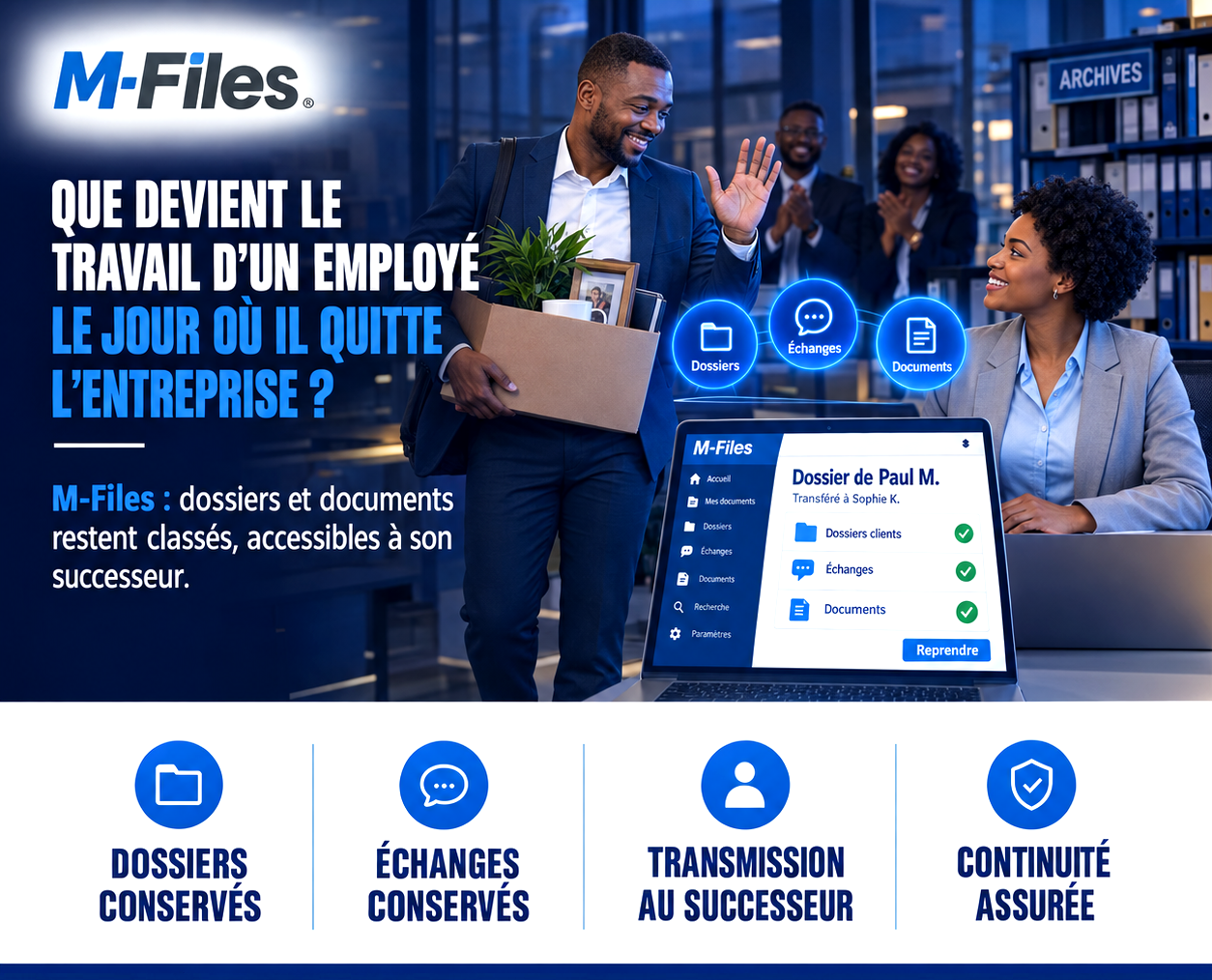
WHAT HAPPENS TO AN EMPLOYEE'S WORK THE DAY THEY LEAVE THE COMPANY?
What happens to an employee's work the day they leave the company? Files, exchanges, and documents kept and handed over to their successor: discover how M-Files ensures continuity.
Galaxy Conseils • Banking & financial institutions sector
Paul M. had been a relationship manager at the branch for eight years. This Friday, his colleagues applaud him: he's leaving to take on a new challenge in another city. A fine send-off, full of good memories.
Among his clients is Aïcha. Société Alpha is bidding on a major tender, and Aïcha needs a bank guarantee before the deadline. Paul had everything in hand: the request, the company's documents, his exchanges with Aïcha and with the commitments department.
The following Monday, Sophie K. takes over his portfolio. But Paul's exchanges stayed in his mailbox, now closed. Some documents are on his computer, others in a binder. And whatever Paul had agreed with Aïcha, no one wrote it down.
Sophie calls Aïcha: "Could you resend us your documents?" Aïcha doesn't understand. She already sent everything, and the deadline is approaching.
The guarantee is finally issued the day before the deadline, after days of stress. Aïcha nearly lost the contract. And she wonders if her bank really knows her company, or only the advisor who just left.
Departures are part of company life: transfers, promotions, retirement, resignation. But when an employee's work is stored in their mailbox, on their computer, or only in their memory, part of that work leaves with them. The consequences are well known:
For a bank, it's also a risk: a forgotten commitment, a missed deadline, or a document that can't be found during an audit.
The solution is simple to state: every important document and exchange should be saved in the client's file, not in an employee's personal space. That way, when someone leaves, their successor inherits a complete file, not a blank page.
Let's revisit Paul's story, this time in a bank that uses M-Files.
Sophie calls Aïcha, but for a different reason: "Hello, I'm Sophie, your new relationship manager. I've taken over your file. Your guarantee will be ready Wednesday."
Aïcha submits her bid on time. And she discovers that her bank knows her company, no matter which advisor she's talking to.
Files preserved. Files and documents stay organized within the company, not on a workstation or in a personal binder.
Exchanges preserved. Important emails and attachments are linked to the relevant file. The history of the client relationship doesn't disappear.
Handover to a successor. The portfolio is reassigned in a few clicks. The successor finds everything, in one place.
Continuity ensured. Clients see no difference: their requests move forward, deadlines are met.
In M-Files, a document doesn't belong to a personal folder: it's linked to a client, a contract, or a case. Whoever owns the file is just a piece of information, one that can be changed when an employee leaves. Access rights follow automatically.
Email integration makes it possible to save an email and its attachments to the right file without copying it. And because every document keeps its history, the successor knows what was done, by whom, and when.
An employee's departure stays a meaningful moment for a team. With M-Files, it doesn't become a risk for your clients.
Ask yourself:
"If one of your relationship managers left on Friday, would their successor find all their files, exchanges, and open commitments by Monday?"
If the answer is "not all of them," it's time to protect your teams' work.
At Galaxy Conseils, we help banks and financial institutions organize their client files with M-Files, so every departure becomes a simple handover. Want to see what this would look like at your bank?
Galaxy Conseils: innovation at the service of your performance.

Can your new hire find what they need on their own? Procedures, templates, position files, and training all in one place: discover how M-Files speeds up onboarding.
Read more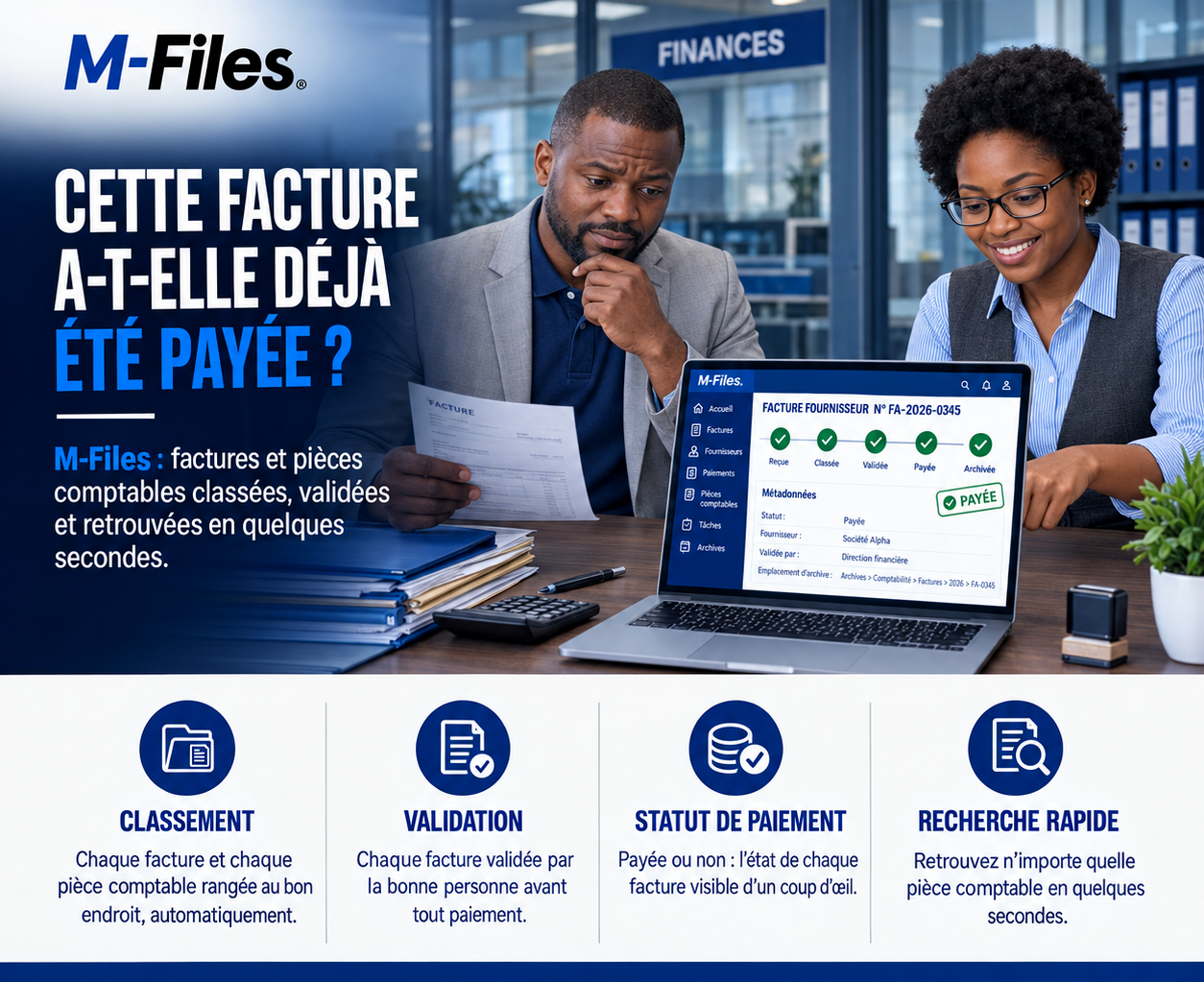
Has this invoice already been paid? Duplicate invoices, late supplier payments, missing accounting documents: discover how M-Files classifies, validates, and tracks every invoice.
Read more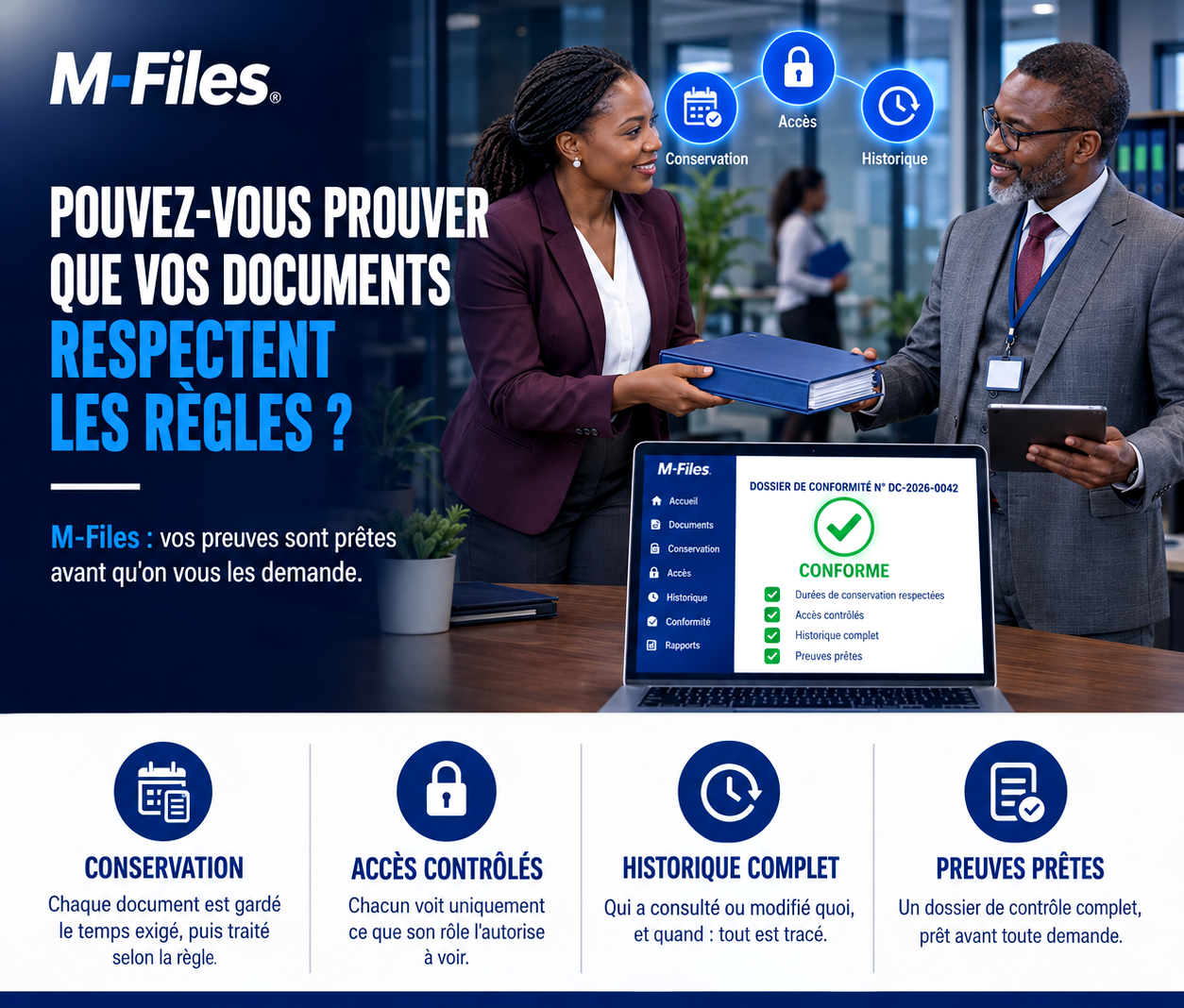
An inspection has been announced: can you prove your retention periods, access controls, and document history? Discover how M-Files prepares your evidence before anyone asks for it. Contenu
Read moreContact us to learn more about our news and upcoming events.
Our offers, news and document management tips, straight to your inbox. One e-mail a month at most.
Unsubscribe in one click at any time. Privacy policy
Check your inbox
We've sent you a confirmation link. Click it to complete your sign-up.
Comments
No comments yet. Be the first to react!