
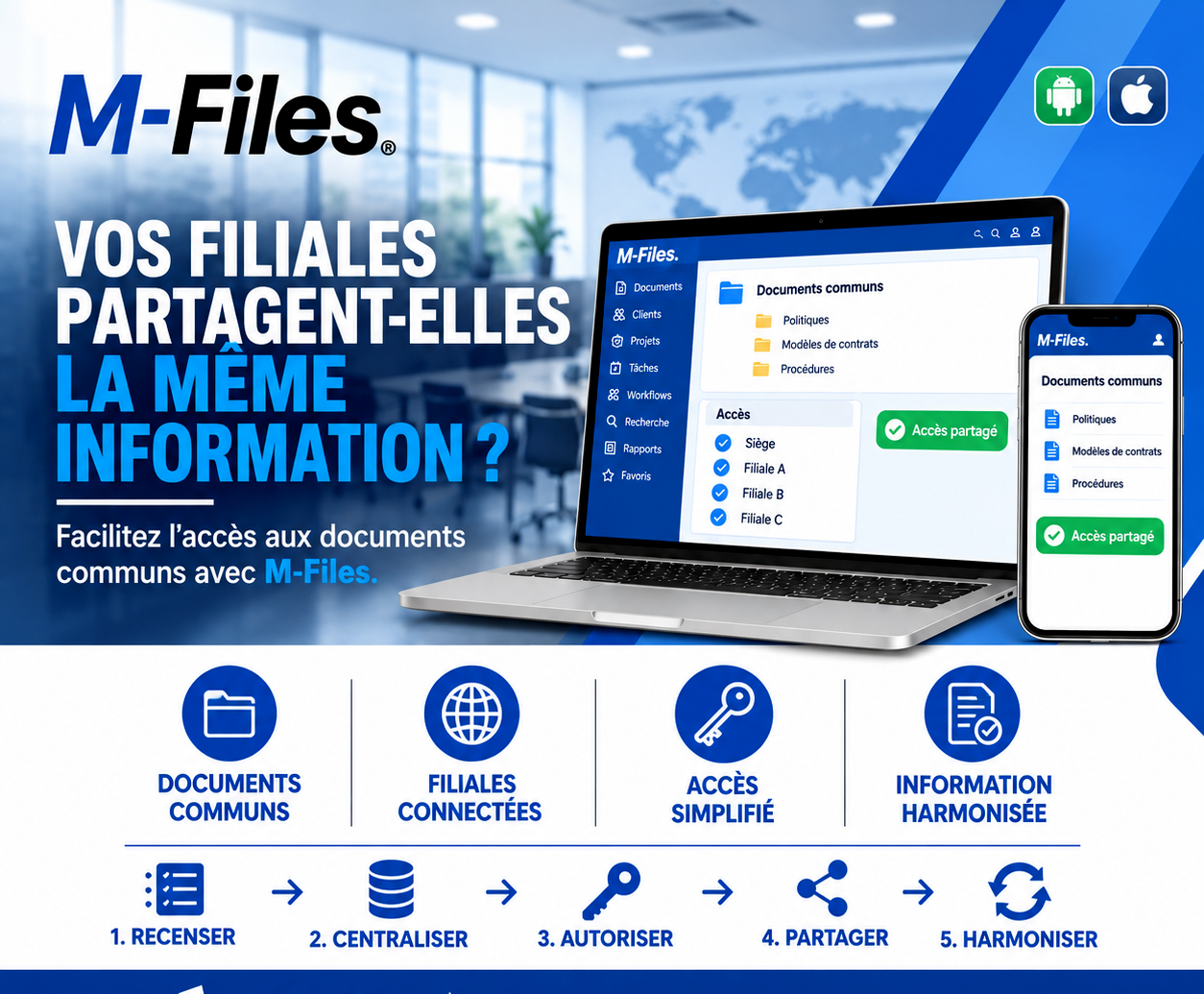
DO YOUR SUBSIDIARIES SHARE THE SAME INFORMATION?
Shared documents, connected subsidiaries, simplified access, harmonized information: discover how M-Files aligns head office and subsidiaries.
Galaxy Conseils • Banking groups & multi-subsidiary networks
Société Alpha is expanding beyond Cameroon: Aïcha is opening a branch in a neighboring country. Naturally, she turns to her bank's local subsidiary, part of the same group. "This will be simple," she thinks, "they already know me."
In Douala, her advisor had given her the list of documents needed to open a business account. But at the subsidiary, she's given a different one: some documents added, others worded differently. The account agreement template isn't the same either, and a clause negotiated with head office is missing from it.
The reason is simple. Head office updated its onboarding policy and contract templates six months ago. The new version was sent to the subsidiaries by email. One applied it, another filed it away in a folder, a third never received it.
Aïcha loses three weeks and has to redo part of her paperwork. To her, it's the same group, under the same name. Yet from one country to the next, it isn't the same information.
Banking groups present in several countries, or companies with multiple subsidiaries, share common rules: internal policies, procedures, contract templates, charters. But when these documents circulate by email or get copied onto each subsidiary's servers, they end up diverging.
Different versions. Each subsidiary applies the version it received, or the one it kept.
Updates that don't arrive. A new policy adopted at head office takes months to be applied everywhere, when it is at all.
Clients treated differently. The same requirements aren't applied the same way from one country to another.
A compliance risk. The group can't guarantee its rules are followed across all its entities.
The solution is to manage shared documents in a single place, with a single version in force, accessible to every authorized entity. Head office updates once; every subsidiary immediately sees the new version. Each subsidiary can, when needed, add its own local adaptations, clearly identified as such.
Let's replay Aïcha's story, this time at a banking group using M-Files.
1. Identify. Head office identifies the documents that should be common to the whole group: policies, contract templates, procedures.
2. Centralize. These documents are brought together in a "Shared Documents" space in M-Files, in their one version in force.
3. Authorize. Access is opened to Head Office, Subsidiary A, Subsidiary B, and Subsidiary C, each according to its rights: head office edits, subsidiaries view and apply.
4. Share. When head office updates the onboarding policy, every subsidiary immediately sees the new version, on computer as well as on mobile. The "Shared access" badge confirms it.
5. Harmonize. Local adaptations, required by a country's regulations, are added as clearly identified supplements, without altering the shared document.
At the subsidiary, Aïcha's advisor opens the same document list and the same agreement template as in Douala. He also sees the file already built in Cameroon, within the limits of what the group's rules and local regulations allow to be shared.
The branch's account is opened within a few days. Across the border, Aïcha finds the same bank and the same rules.
Shared documents. Policies, procedures, and contract templates managed in a single place, in a single version in force.
Connected subsidiaries. Head office and every subsidiary access the same space, with no files to send each other.
Simplified access. Every entity finds the up-to-date document in seconds, according to its rights.
Harmonized information. The same rules are applied everywhere, with local adaptations clearly identified.
M-Files makes it possible to manage, in the same environment, documents shared across the whole group and documents specific to each entity. Access rights define who can view, who can edit, and who must approve, for each subsidiary.
The document lifecycle applies at group level: when a policy is replaced, the old version stays available in the history, but only the new one is shown as currently in force. Workflows can even ask each subsidiary to confirm it has acknowledged an update.
Depending on how the group is organized, M-Files can be deployed in the cloud or across several linked sites, taking into account each country's rules on data location.
Ask yourself:
"If your head office updated a policy today, how long would it take to be certain every subsidiary was applying the new version?"
If you can't answer with certainty, your subsidiaries deserve a common source of information.
At Galaxy Conseils, we help banking groups and multi-site companies organize the sharing of their common documents with M-Files, while respecting each entity's specifics. Want to see concretely what this would look like for your group?
Galaxy Conseils: innovation serving your performance.
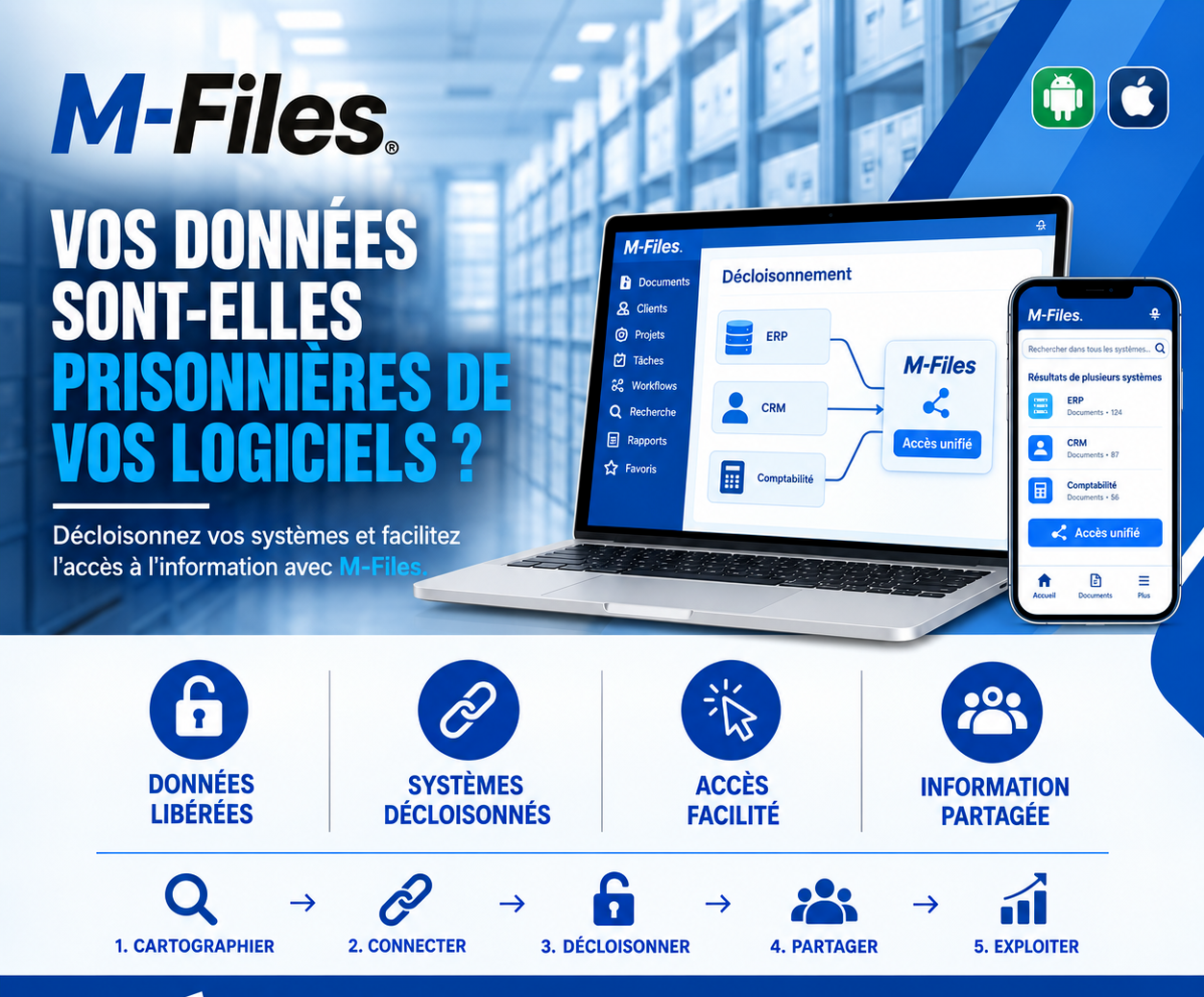
Is your data trapped inside your software? Freed data, unsiloed systems, easier access, shared information: discover how M-Files opens up access to information without changing your tools.
Read more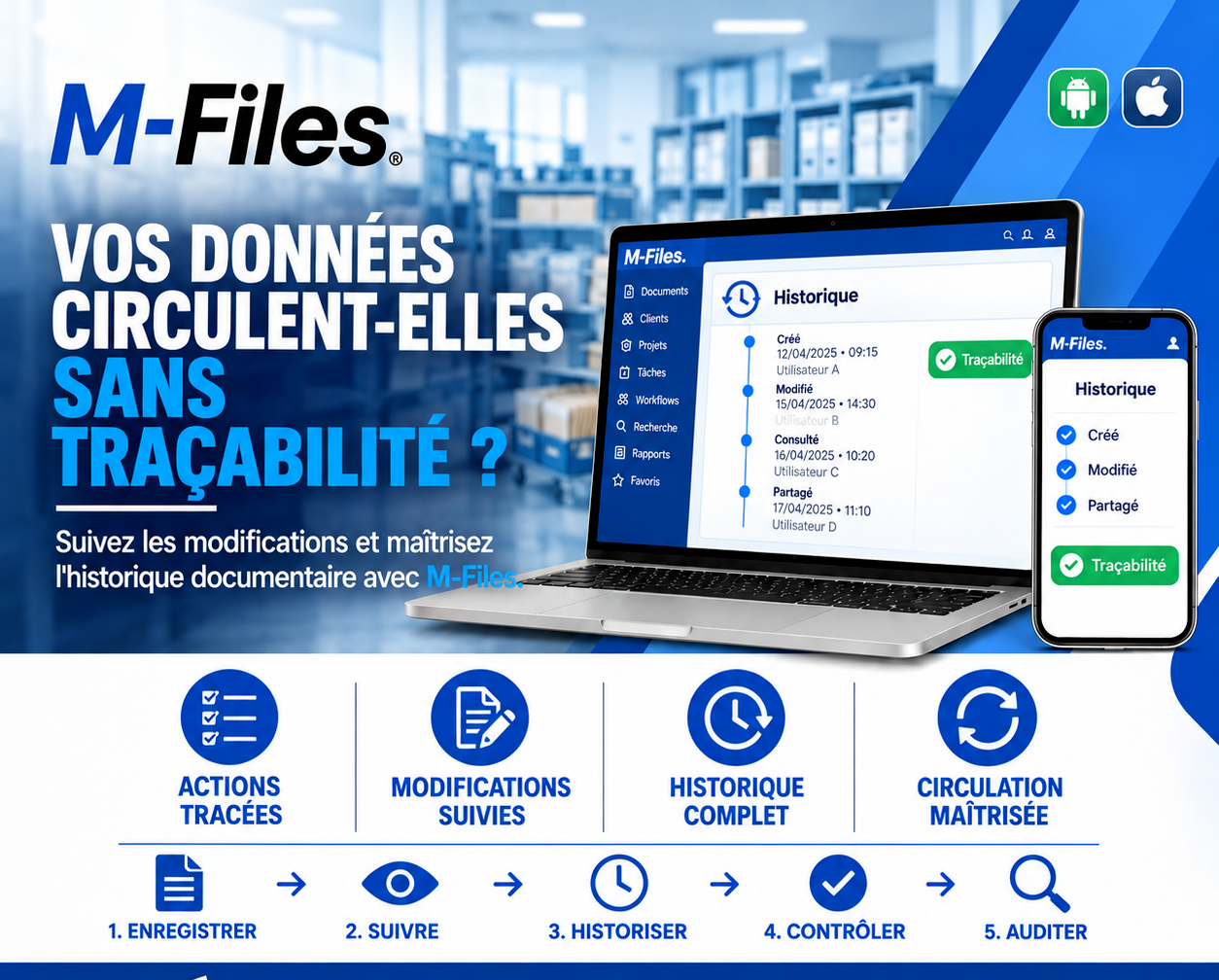
Is your data circulating without traceability? Tracked actions, monitored changes, complete history, controlled circulation: discover how M-Files follows every document, from creation to sharing.
Read more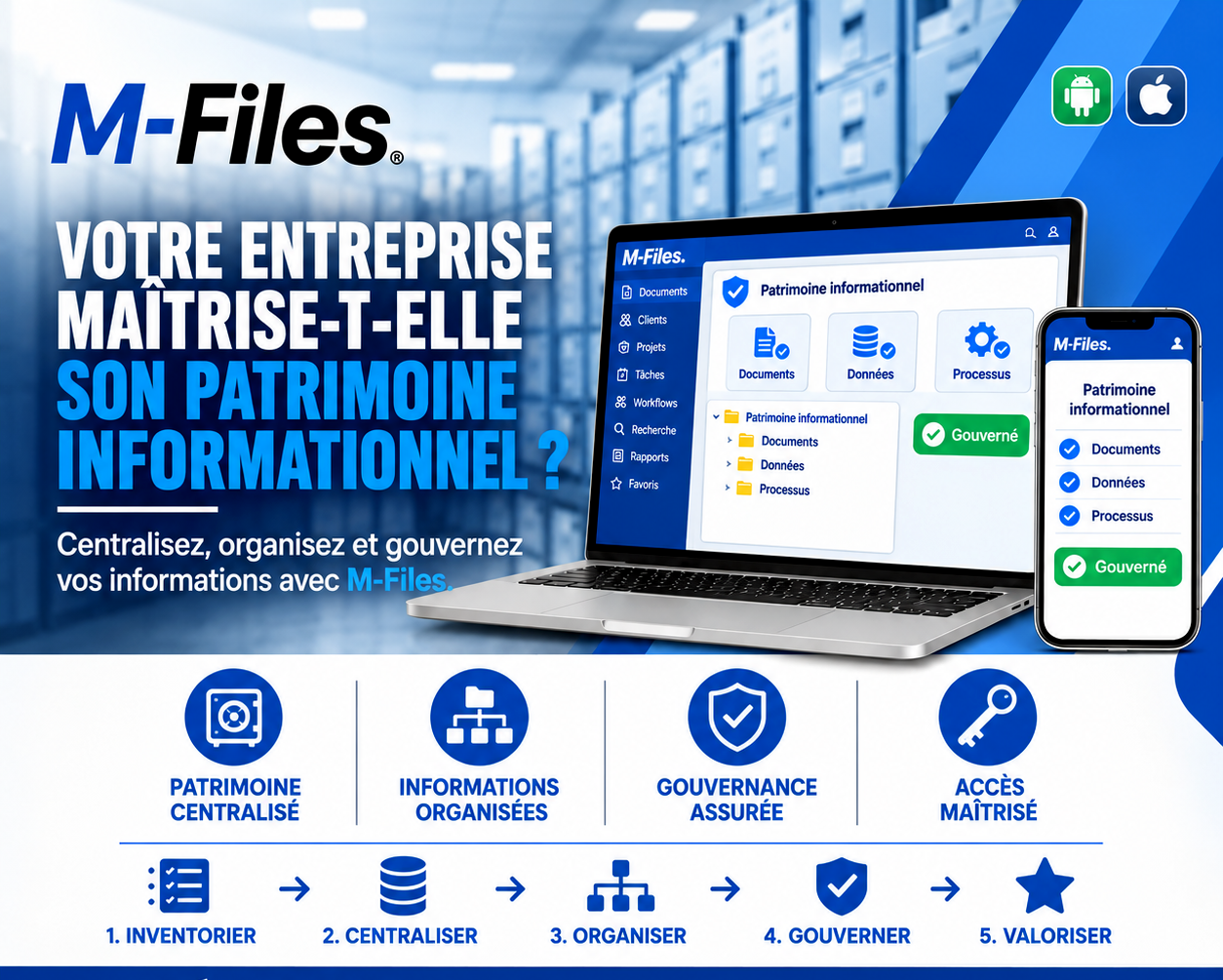
Does your company master its information assets? Documents, data and processes centralized, organized and governed: discover how M-Files turns information into an asset.
Read moreContact us to learn more about our news and upcoming events.
Our offers, news and document management tips, straight to your inbox. One e-mail a month at most.
Unsubscribe in one click at any time. Privacy policy
Check your inbox
We've sent you a confirmation link. Click it to complete your sign-up.
Comments
No comments yet. Be the first to react!