
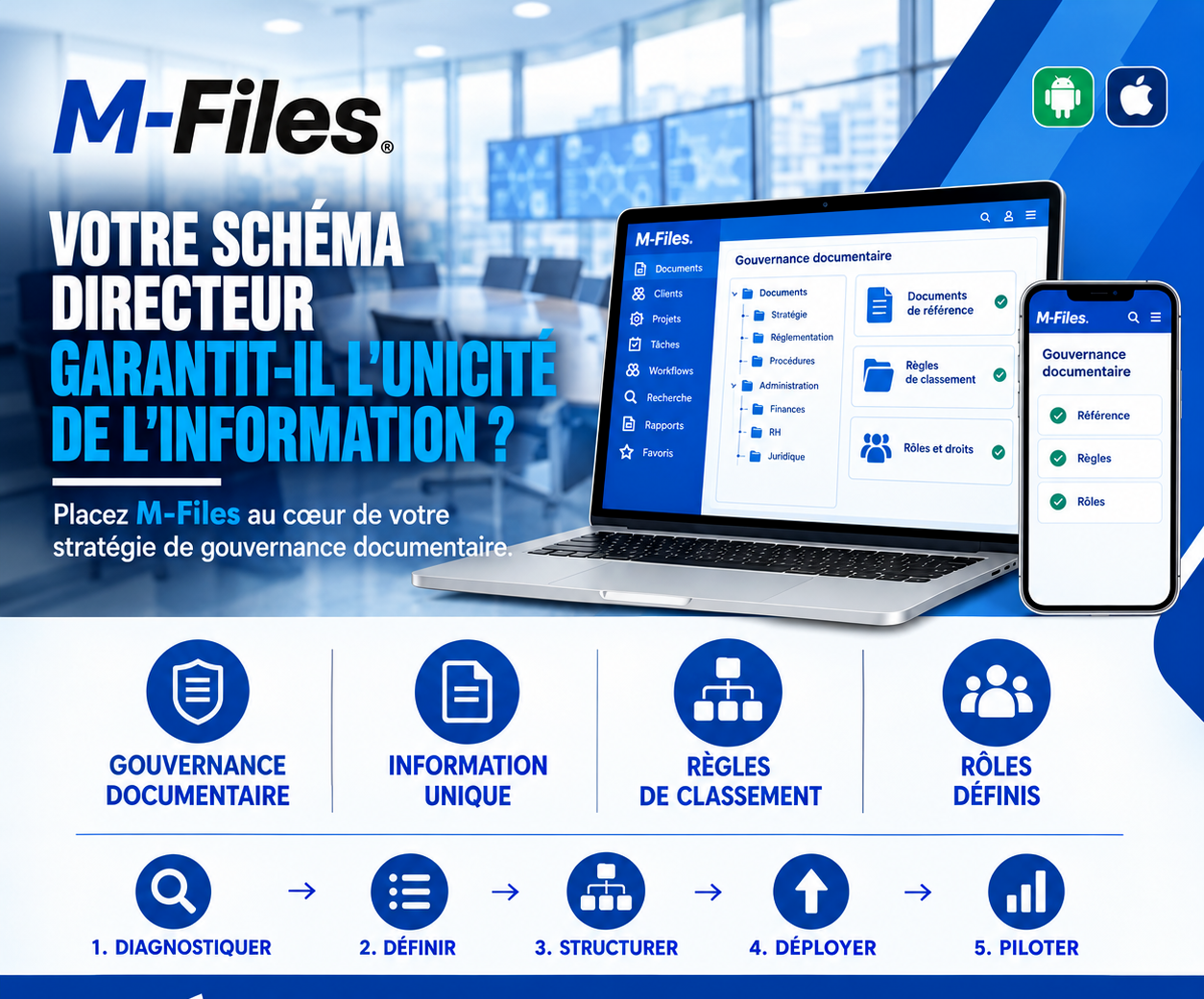
DOES YOUR IT MASTER PLAN GUARANTEE A SINGLE SOURCE OF INFORMATION?
Document governance, a single source of information, classification rules, defined roles: put M-Files at the heart of your strategy.
Galaxy Conseils • Banking sector & financial institutions
Three years ago, the bank adopted an ambitious IT master plan: new banking software, a mobile app, a customer relationship tool, branch digitization. The projects were run one by one, each with its own team, budget and timeline.
Each project succeeded in its own way. But the question of documents was never addressed as a whole. The credit project created its own digital folders, so did the HR project, the legal department kept its own server, and branch digitization produced thousands of files organized according to a different logic at each site.
Today, Société Alpha's file exists in four places, organized in four different ways. When Aïcha asks for a complete history of her commitments to prepare for a new partner joining, no one knows where to start. Senior management discovers that, despite all the investment, the bank still does not have a single source of information.
The master plan had planned for the software. It had forgotten the governance of the information flowing between them.
An IT master plan sets an organization's major technology directions for several years. It often covers software, infrastructure and projects. But without a document governance component, it leaves out an essential question: how do you guarantee that a piece of information exists only once, in the right place, under someone's responsibility?
Every project creates its own classification. The rules change from one department, tool or site to another.
Roles are not defined. No one knows who is responsible for which type of document.
Duplicates multiply. The same document exists in several tools, in several versions.
Governance comes too late. People try to restore order afterwards, once the disorder has already set in.
Document governance comes down to simple but structuring choices: what are the reference documents, how are they classified, who can create, modify, approve and view them, and how long are they kept. Once defined, these choices need to be applied through a shared tool rather than separately by each project.
Imagine that Aïcha's bank builds document governance into its IT master plan, with M-Files as the shared foundation.
1. Assess. Galaxy Conseils takes stock with the bank: which documents, which tools, which classifications, which duplicates, which risks.
2. Define. The bank sets its framework: reference documents, classification rules, roles and rights. For example, client files fall under the sales department, master agreements under legal.
3. Structure. These rules are translated into M-Files: broad families (Strategy, Regulation, Procedures, Administration, Finance, HR, Legal), mandatory metadata, role-based permissions.
4. Deploy. M-Files is rolled out progressively and connected to the master plan's other tools. Every new project uses the same rules instead of inventing new ones.
5. Steer. Dashboards make it possible to track how the rules are applied: documents with no owner, duplicates, documents awaiting approval.
When Aïcha asks for the history of her commitments, the bank provides it within a day, from a single client file. And every new IT project enriches that single source of information, instead of scattering it further.
Document governance. Clear rules, decided at management level and applied everywhere.
A single source of information. Every reference document exists only once, in the right place.
Shared classification rules. Every department and every project files information the same way.
Defined roles. Everyone knows which documents they are responsible for, and what they can do with them.
M-Files does more than just store files: it applies rules. Mandatory metadata, role-based permissions, approval workflows and retention periods are configured once, then applied automatically to every document.
It also integrates with the other building blocks of the information system, banking software, email, business tools, which makes it a natural foundation for document governance within an IT master plan, without replacing existing tools.
Finally, its rollout can follow the pace of the master plan: a first scope, then an extension department by department.
Ask yourself the question:
"Does your IT master plan specify who is responsible for each type of document, and what rules govern how it is classified and retained?"
If the answer is no, your strategy is missing an essential component.
At Galaxy Conseils, we support senior and IT management teams in defining their document governance and deploying it with M-Files, from assessment through to steering. Want to build document governance into your IT master plan?
Galaxy Conseils: innovation serving your performance.
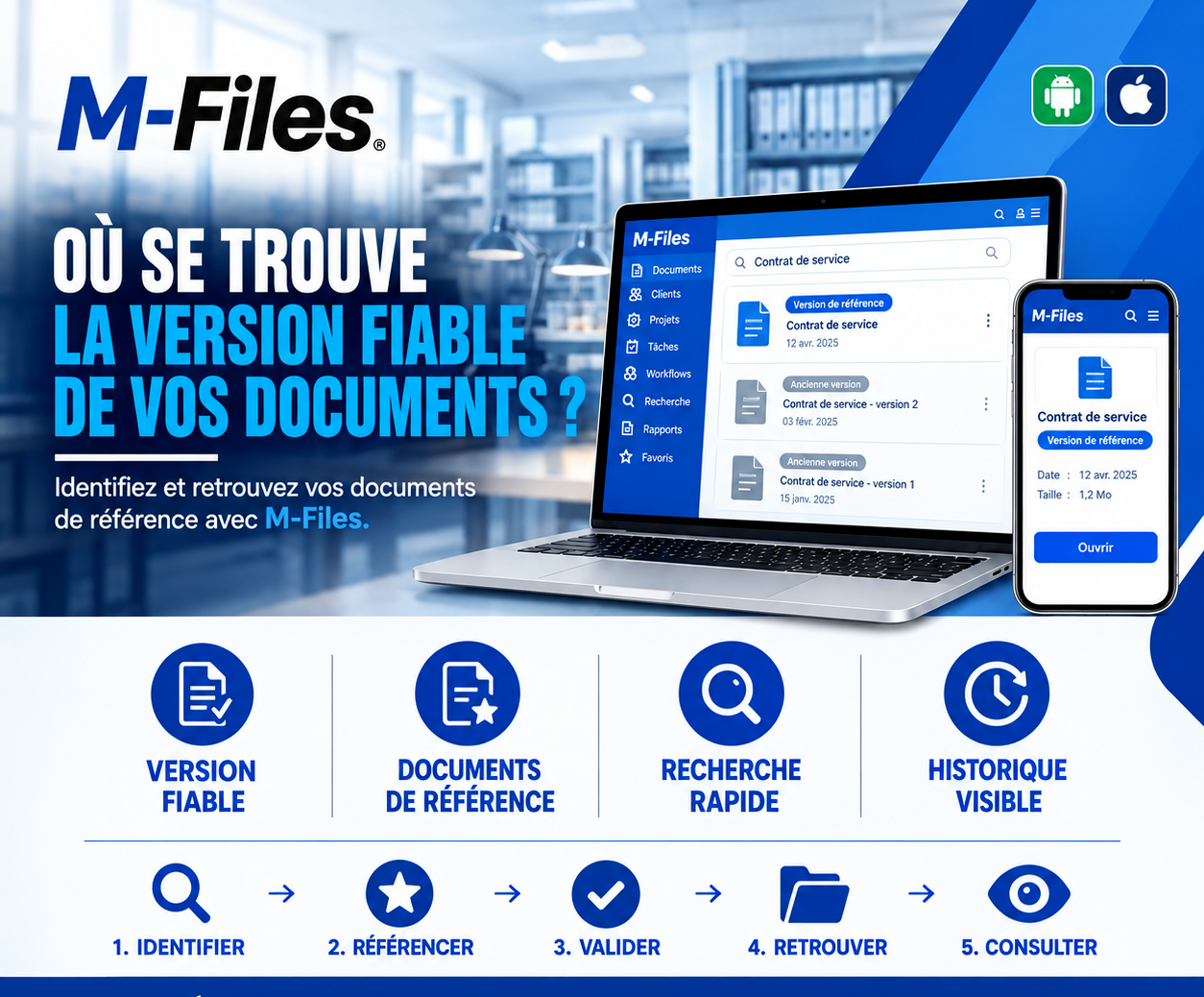
Where is the reliable version of your documents? Reliable version, reference documents, fast search, visible history: discover how M-Files tells the right version apart from the old ones.
Read more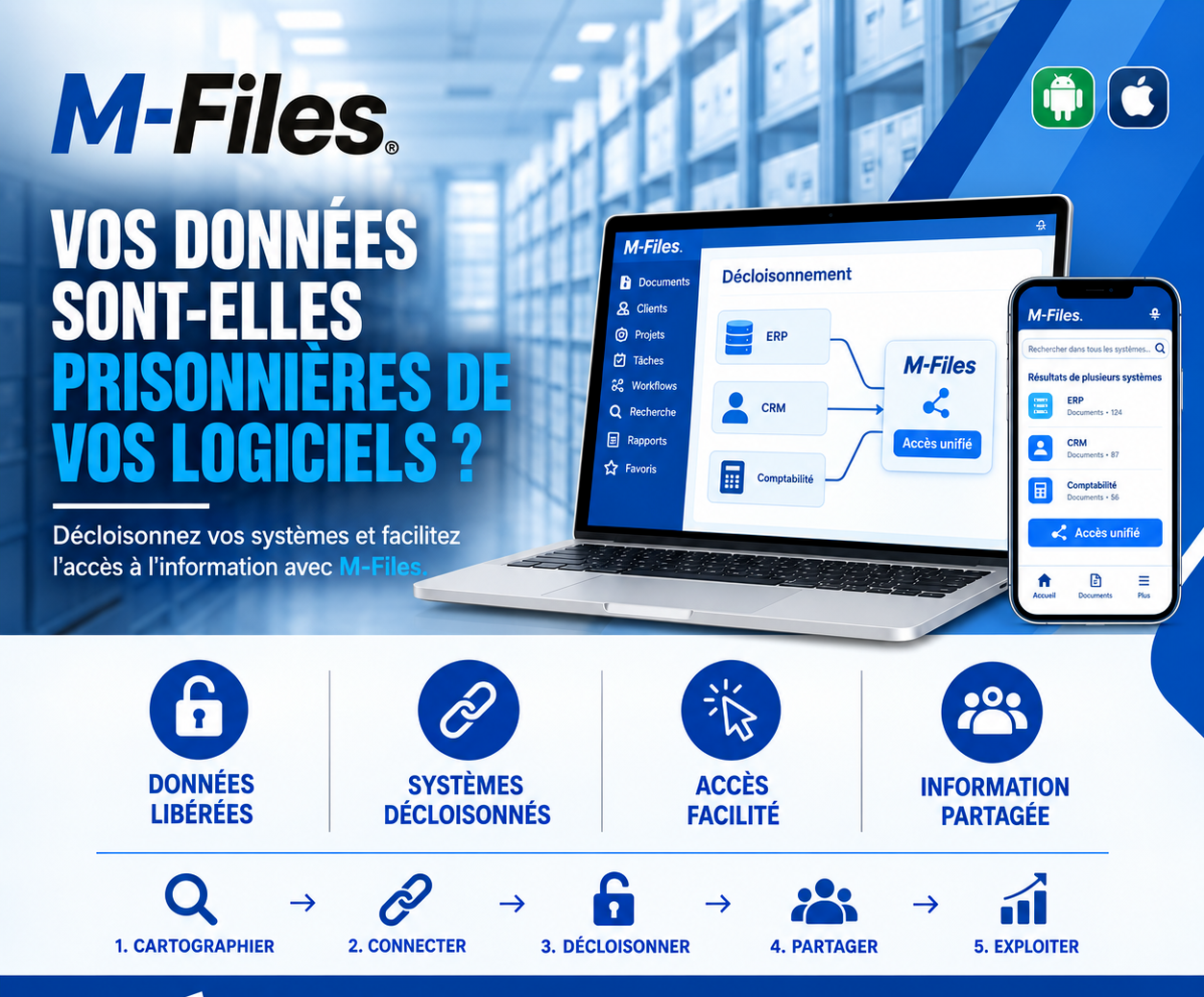
Is your data trapped inside your software? Freed data, unsiloed systems, easier access, shared information: discover how M-Files opens up access to information without changing your tools.
Read more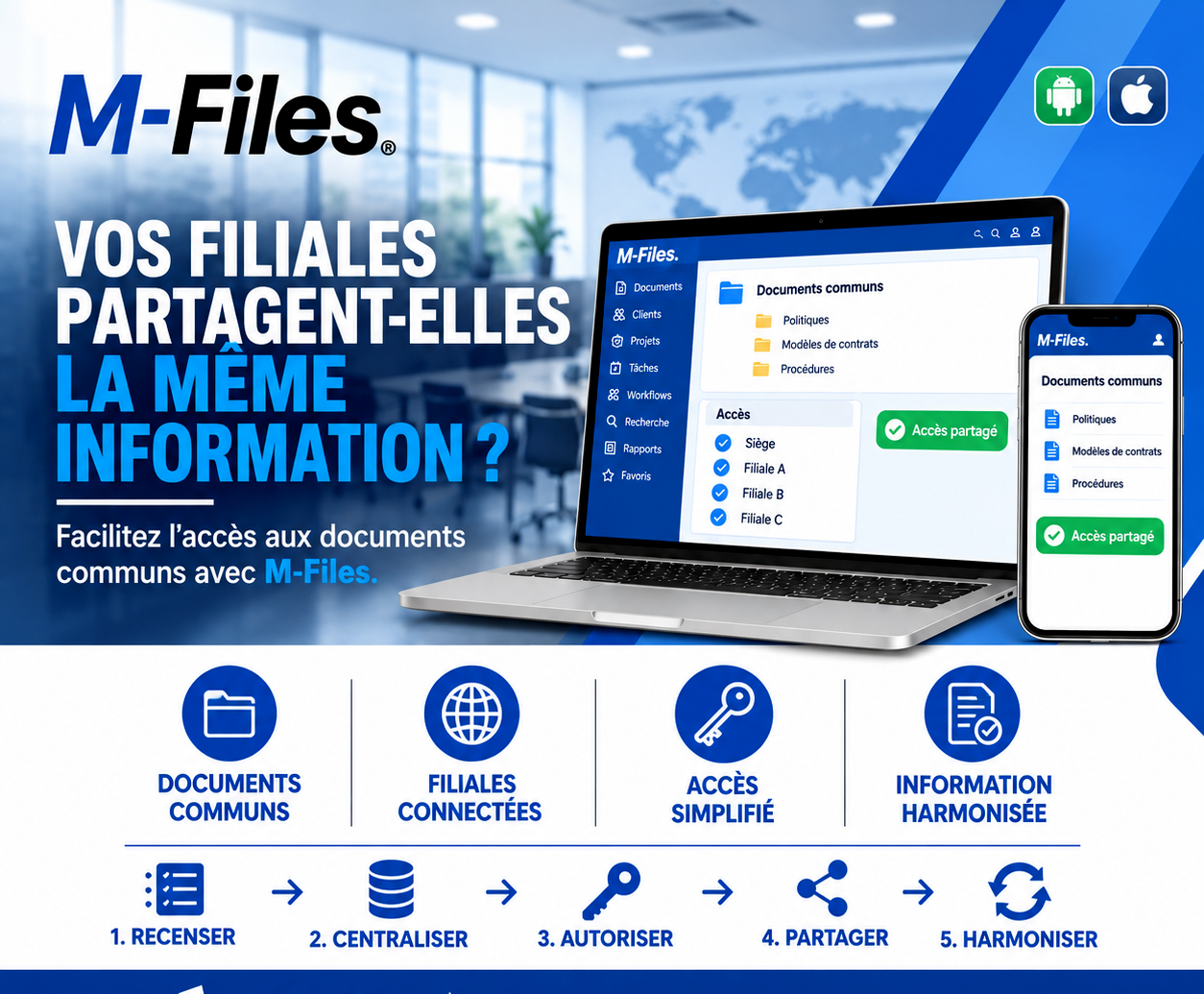
Do your subsidiaries share the same information? Shared documents, connected subsidiaries, simplified access, harmonized information: discover how M-Files aligns head office and subsidiaries.
Read moreContact us to learn more about our news and upcoming events.
Our offers, news and document management tips, straight to your inbox. One e-mail a month at most.
Unsubscribe in one click at any time. Privacy policy
Check your inbox
We've sent you a confirmation link. Click it to complete your sign-up.
Comments
No comments yet. Be the first to react!